Report Overview
Discolouration Serum Market - Highlights
Discolouration Serum Market Size:
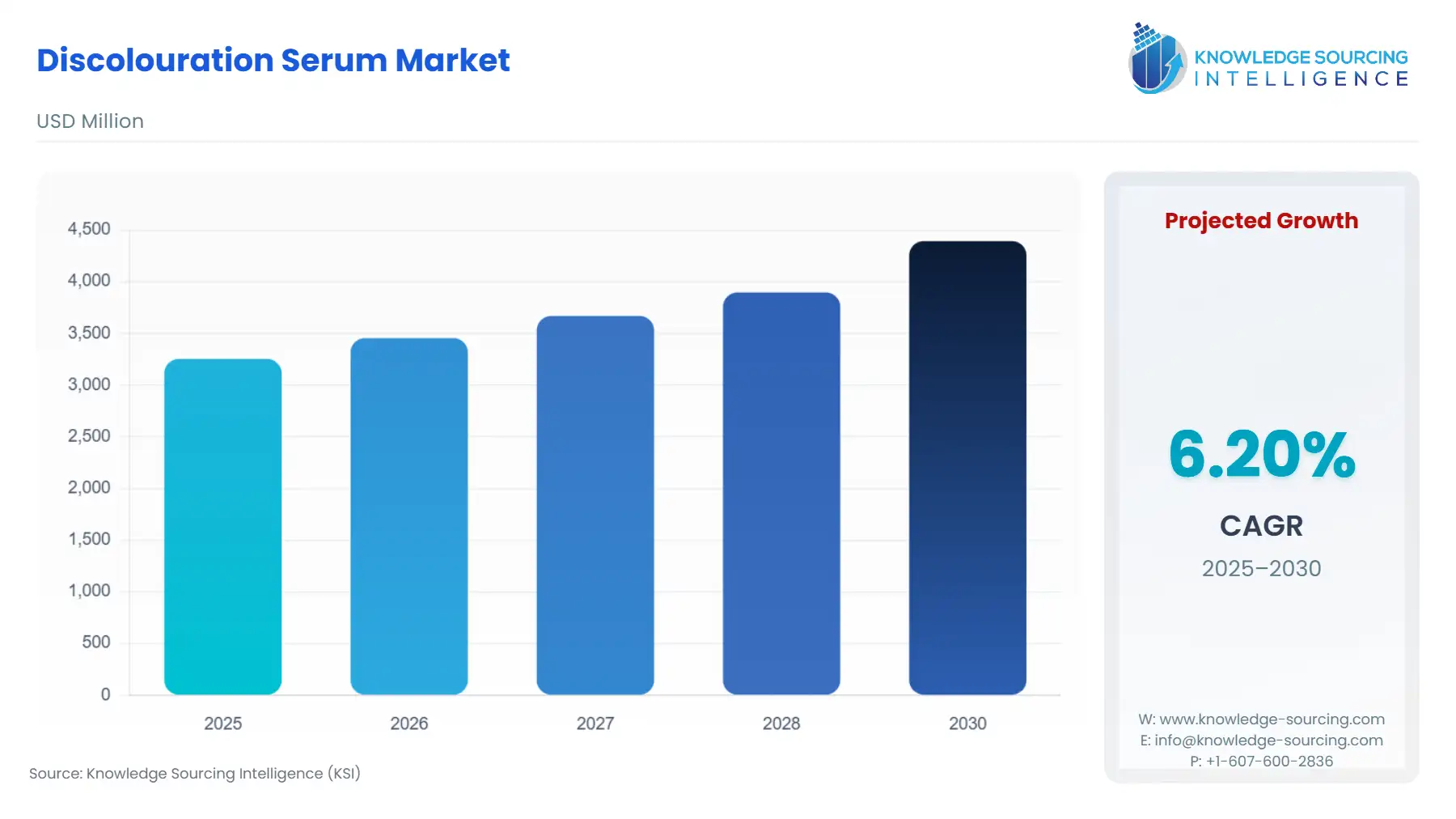
The Discolouration Serum Market is expected to grow at a CAGR of 6.20%, reaching a market size of US$4.395 billion in 2030 from US$3.254 billion in 2025.
Discoloration serum specifically treats uneven skin tone (dark spots) and hyperpigmentation. It contains strong but gentle ingredients that help reduce sun, acne, or age-related discolorations. Due to its fast absorption, such serum is easily incorporated into any daily regimen and on all skin types.
Brands have been developing advanced-formulated serums with compounds like niacinamide, vitamin C, and kojic acid. The craze for "clean beauty" has further augmented the demand for serums with natural and cruelty-free formulations. Presently, these products are made available to a more comprehensive range of customers through the significant online marketing of products.
The discoloration serum market is growing steadily, fuelled by increasing consumer skin care awareness and increased motivation to achieve healthy skin that is uniformly toned and radiant. With mounting concerns over sun damage, aging, and post-acne marks, there is a growing demand for these types of targeted therapies, such as discoloration serums.
What are the Discoloration Serum Market drivers?
Increased health and hygiene awareness is propelling the market expansion
Modern consumers are adopting skincare rituals as part of their self-care routines, emphasizing increasing knowledge of familiar skin problems such as hyperpigmentation, dark spots, or uneven skin tone. They want to know about specific solutions to help with these problems as they learn more about healthy and clear skin. Hence, public awareness regarding the benefits of specific treatments is accelerating the demand for discoloration serums.
The online platforms present valuable skincare advice on demand for customers, eventually translating into rising demand for face care solutions that treat pigmentation but also without complicated and invasive procedures. According to Cosmetics Italia, in 2023, skincare constituted 16% of overall cosmetics consumption in Italy, with a consumption valuation of up to EUR 1,612 million, signifying a 9.5% growth over the previous year’s consumption scale. Today, discoloration serums are widely recognized for their honest, visible results, and when it comes to qualities such as safety and non-invasiveness, they are at the top of the list.
Advancements in the skincare formulations is stimulating market growth
The discoloration serum market growth has been driven largely by innovations in skincare technology. The growing number of informed consumers constantly looking for an effective means of tackling problems like hyperpigmentation and uneven skin tone is pushing brands to develop promising new efficacy serums. Thus, serums are now concentrated with effective but gentle agents that target melanin activity inhibition or reabsorption while being less irritating to the skin. Along with modified product attributes, consumerism is steadily leaning toward clean, sustainable, and cruelty-free beauty products.
There has been a greater acceptance of these discoloration serums due to ethical and eco-consciously consumerist choices. Nowadays, consumers are more interested in products that meet high standards of sustainability and ethical production.
Major challenges hindering the Discolouration Serum Market:
Concern regarding side effects and regulatory complications can hamper the market expansion
Some consumers can be skeptical about the functioning of such serums, as an individual might have enough experience with trying many products without much success to be wary of trying others. A similar period of not really fast but steady results can slow down their adoption rates. The regulatory complications ensuring the safety and ingredient standards in different regions are also pretty complicated to follow. The high prices featured in the premium discoloration serums also limit their availability for cheaper consumers. Adding to the shifting consumer preferences, such things are another difficult hurdle that may slow down the discoloration serum market expansion.
The discoloration serum market has several challenges that block its chances of growth. First among them is the immense competition in the skincare industry. Too many brands offering similar things make it uncomfortable for smaller or newer brands to market themselves distinctively.
Geographical outlook of the Discolouration Serum Market:
The Asia Pacific region is poised for steady growth
By geography, the discoloration serum market is segmented into North America, South America, Europe, the Middle East & Africa, and Asia Pacific. Asia-Pacific, including major regional economies, namely India, China, and Japan, will considerably be at the forefront of regional market growth due to varied economic factors such as rapid urbanization, improvement in consumer purchase power, and booming self-consciousness, followed by higher income levels. There is also heightened awareness of skincare routines and the importance of hyperpigmentation, dark spots, and uneven skin tone among consumers in these markets.
In India and China, where the skincare market is fast developing, consumers are looking to try out products that promise brighter and even skin more than ever. In Japan, such serums have gained popularity as part of an already-established beauty routine. Additionally, major cosmetics brands, namely Shiseido, L’Oreal, and Johnson & Johnson, have established their businesses in such regional economies and are investing constantly in new skin & face care serums. These combined facts drive the increase in demand for discoloration serums across the Asia-Pacific market, making it one of the prime growing markets.
Key developments in the Discoloration Serum Market:
In September 2022, L'Oréal USA invested $140 million in a new research and innovation (R&I) center in New Jersey, USA. The center will use green science and beauty technology to focus on beauty innovation across skin, hair, and makeup categories. The R&I center is spread across 250,000 square feet and would amalgamate more than 550 employees from the company's North American research and innovation, including advanced product development and research & evaluation.
Discolouration Serum Market Scope:
| Report Metric | Details |
|---|---|
| Total Market Size in 2025 | USD 3.254 billion |
| Total Market Size in 2030 | USD 4.395 billion |
| Forecast Unit | Billion |
| Growth Rate | 6.20% |
| Study Period | 2020 to 2030 |
| Historical Data | 2020 to 2023 |
| Base Year | 2024 |
| Forecast Period | 2025 – 2030 |
| Segmentation | Product Type, Form, Formulation, Geography |
| Geographical Segmentation | North America, South America, Europe, Middle East and Africa, Asia Pacific |
| Companies |
|
Discolouration Serum Market Segmentation:
By Product Type
Vitamin C Serums
Niacinamide Serums
Kojic Acid Serums
Others
By Form
Water Based
Oil Based
Gel Based
Others
By Formulation
Natural and Organic
Synthetic
Vegan and Cruelty-Free
By Distribution Channel
Online
Offline
Specialty Stores
Supermarkets and Hypermarkets
Pharmacies and Drugstores
By Geography
North America
USA
Canada
Mexico
South America
Brazil
Argentina
Others
Europe
United Kingdom
Germany
France
Italy
Spain
Others
Middle East and Africa
Saudi Arabia
UAE
Others
Asia Pacific
China
India
Japan
South Korea
Thailand
Indonesia
Others