Report Overview
3D Printing Surgical Models Highlights
3D Printing Surgical Models Market Size:
3D Printing Surgical Models Market is projected to expand at a 14.08% CAGR, attaining USD 914.147 million in 2031 from USD 414.628 million in 2025.
3D Printing Surgical Models Market Trends:
3D printing surgical models are precise replicas of a patient's anatomy which allows surgeons to better plan and practice complex procedures before performing them on the actual patient. Multiple advantages and growing demand for minimally invasive surgeries are major growth drivers of the 3D printing surgical models market. Moreover, the rising cases of chronic illnesses such as cancer, cardiovascular diseases, and others are further propelling the market expansion. Additionally, the increasing investments and technological advancements resulting in enhanced product launches are also expected to boost the 3D printing surgical models market.
3D Printing Surgical Models Market Growth Drivers:
Multiple Deployment Advantages
The multiple advantages associated with 3D models are a major growth driver of the 3D printing surgical models market. The anatomy of a patient is represented in great accuracy and detail by 3D surgical models, which enable surgeons to carefully evaluate and plan surgical treatments. Surgeons can perform virtual surgeries on the model, familiarize themselves with the steps, and refine their techniques. This preoperative practice helps improve surgical precision, reduces operative time, and increases surgeon confidence. Patients can better understand their condition and the proposed procedures, leading to improved informed consent. The visual and tactile nature of the models enhances patient education, allowing them to make more informed decisions about their treatment.
Growing Demand for Minimally Invasive Surgeries
The rise of minimally invasive surgical techniques, such as laparoscopy and robotic-assisted surgery, demands a high level of precision and spatial awareness. 3D-printed surgical models assist surgeons in getting acquainted with the unique anatomical variances of individual patients, determining optimal trocar placements, and honing their skills in manipulating surgical instruments. The growing demand for minimally invasive procedures is therefore expected to propel the 3D printing surgical models market. For instance, out of a total of 15.6 million cosmetic surgeries processed in 2020, 13.2 million were minimally invasive surgeries as per the American Society of Plastic Surgeons.
Increasing Incidence of Chronic and Other Serious Diseases
3D-printed surgical models can help in treatment planning for patients with chronic disorders, such as cardiovascular issues or orthopaedic conditions. 3D surgical models can assist in treatment planning. The rising cases of chronic conditions are contemplated to propel the 3D printing surgical models market. For instance, according to the WHO estimates, 17.9 million deaths worldwide in 2019 were attributable to cardiovascular diseases (CVDs) representing 32% of all fatalities. In the United States, CVD claims more lives each year than all types of cancer and Chronic Lower Respiratory Disease (CLRD) put together as per the American Heart Association.
3D Printing Surgical Models Market Opportunities:
A large number of surgical specialities have the potential to greatly increase their utilization of 3D-printed surgical models. There are chances to investigate the technology's potential in other specialties including urology, dentistry, plastic surgery, and more in the coming years thereby providing an ample opportunity for 3D printing surgical models market expansion. The use of 3D-printed surgical models may become more widespread as surgeons and medical professionals learn more about the advantages. Moreover, the integration of 3D printing with advanced medical imaging technologies opens up opportunities for developing automated segmentation algorithms, advanced visualization tools, and software solutions that seamlessly convert imaging data into 3D printed models.
3D Printing Surgical Models Market Restraints:
The 3D printing surgical model market has experienced growth and development, however, some restraints or challenges can impact its expansion. Adoption may be significantly hampered by the price of 3D printing technology, materials, and post-processing. The therapeutic usefulness of 3D-printed surgical models depends on their excellent quality and accuracy. Resolution, surface polish, and material qualities may be constrained by the 3D printing process and materials. Moreover, due to compatibility concerns between multiple imaging modalities and software systems, acquiring and integrating high-quality medical imaging data from numerous sources can be difficult.
3D Printing Surgical Models Market Geographical Outlook:
North America is Expected to Grow Considerably
North America is expected to hold a significant share of the 3D printing surgical model market during the forecast period. The factors attributed to such a share are the rising disposable income, R&D initiatives, higher prevalence of chronic diseases, and rising aging population. For instance, the population aged 65 years or above is estimated to grow to over 80 million by 2040 as per the Administration of Community Living (ACL). Moreover, the presence of major market leaders in the region such as Stratasys Ltd., and 3D Systems, Inc. further boosts the 3D printing surgical models market growth through enhanced accessibility and product launches.
3D Printing Surgical Models Market Market Players:
Stratasys Ltd. is one of the leading 3D printing and additive manufacturing companies. Stratasys offers a wide range of 3D printers to cater to diverse industries such as aerospace, automotive, healthcare, consumer products, and more. Their 3D printing technologies include Fused Deposition Modeling (FDM), PolyJet, and Selective Laser Sintering (SLS), among others.
3D Systems is known for its diverse 3D printing technologies, including Stereolithography (SLA), Selective Laser Sintering (SLS), MultiJet Printing (MJP), and Direct Metal Printing (DMP). The VSP® surgical planning solutions from 3D Systems integrate digital workflows with the market's printers for additive manufacturing to give comprehensive patient-matched solutions.
Axial3D is a business that specializes in surgical planning and medical 3D printing. The solutions provided by Axial3D entail the creation of incredibly precise and comprehensive 3D models using medical imaging data, such as those from CT and MRI scans.
3D Printing Surgical Models Market Scope:
| Report Metric | Details |
|---|---|
| Study Period | 2021 to 2031 |
| Historical Data | 2021 to 2024 |
| Base Year | 2025 |
| Forecast Period | 2026 – 2031 |
| Companies |
|
Report Metric | Details |
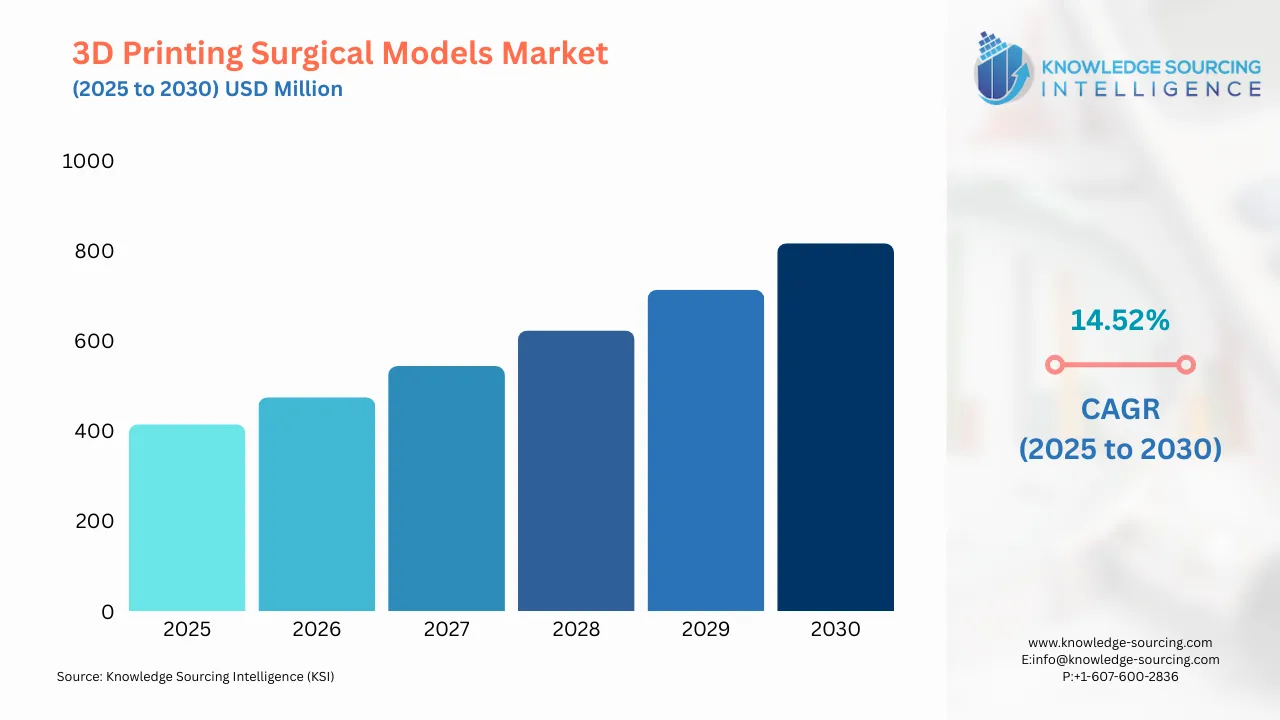
3D Printing Surgical Models Market Size in 2025 | USD 414.628 million |
3D Printing Surgical Models Market Size in 2030 | USD 816.705 million |
Growth Rate | CAGR of 14.52% |
Study Period | 2020 to 2030 |
Historical Data | 2020 to 2023 |
Base Year | 2024 |
Forecast Period | 2025 – 2030 |
Forecast Unit (Value) | USD Million |
Segmentation |
|
Geographical Segmentation | North America, South America, Europe, Middle East and Africa, Asia Pacific |
List of Major Companies in the 3D Printing Surgical Models Market |
|
Customization Scope | Free report customization with purchase |
3D Printing Surgical Models Market Segmentation
By Specialty
Cardiac Surgery/ Interventional Cardiology
Gastroenterology Endoscopy of Esophageal
Neurosurgery
Orthopedic Surgery
Reconstructive Surgery
Surgical Oncology
Transplant Surgery
By Technology
Stereolithography (SLA)
ColorJet Printing (CJP)
MultiJet/PolyJet Printing
Fused Deposition Modeling (FDM)
Others
By Material
Metal
Polymer
Plastic
Others
By Geography
North America
USA
Canada
Mexico
South America
Brazil
Argentina
Others
Europe
Germany
France
United Kingdom
Spain
Others
Middle East and Africa
Saudi Arabia
UAE
Others
Asia Pacific
China
India
Japan
South Korea
Indonesia
Thailand
Others