Report Overview
3D Bioprinting Market - Highlights
3D Bioprinting Market Size:
3D Bioprinting Market is projected to rise, achieving a 13.47% CAGR, to USD 3.584 billion in 2031 from USD 1.679 billion in 2025.
3D Bioprinting Market Trends:
The 3D bioprinting market is experiencing rapid growth, driven by its transformative applications in tissue engineering, regenerative medicine, and drug discovery. This innovative technology uses biomaterials, live cells, and bioinks to create precise three-dimensional structures, revolutionizing healthcare by enabling personalized medicine and addressing organ transplant shortages. The market is propelled by advancements in bioprinter technology, bioink formulations, and increasing investments from pharmaceutical companies, healthcare organizations, and research institutes.
3D bioprinting combines additive manufacturing with biology to fabricate biomimetic tissues and organs. Techniques like extrusion bioprinting, inkjet bioprinting, and laser-assisted bioprinting (LAB) allow precise deposition of living cells and growth factors to form complex tissue constructs. Emerging methods, such as DLP bioprinting and stereolithography bioprinting, offer high-resolution fabrication, while acoustic bioprinting and magnetic bioprinting enable innovative cell placement for intricate structures. 4D bioprinting, incorporating stimuli-responsive materials, and multi-material bioprinting enhance functionality by integrating diverse biomaterials, supporting applications in organ transplantation and drug testing.
The market’s growth is driven by the rising demand for personalized treatments and advancements in tissue modeling. Bioinks, designed for biocompatibility and cell viability, are critical for creating functional tissues that mimic natural microenvironments. Scaffold-free bioprinting is gaining traction, enabling cellular self-assembly for efficient tissue engineering. High-throughput bioprinting accelerates production, supporting scalability in regenerative medicine and 3D cell culture. These innovations address challenges like shear stress on cells, ensuring post-printing functionality.
The Asia-Pacific region, particularly China and Japan, leads the market due to robust biotechnology research and supportive government policies. Investments in healthcare innovation and bioprinting infrastructure drive regional dominance. Globally, pharmaceutical industries leverage 3D bioprinting for drug discovery, creating biomimetic models to test efficacy and safety, reducing reliance on animal testing. The technology’s potential to produce transplantable organs addresses global organ shortages, further fueling market expansion.
Challenges, such as high costs of bioprinters and consumables, persist, but ongoing R&D in bioink development and high-resolution bioprinting is overcoming these hurdles. Trends like biomimicry and smart biomaterials enhance tissue functionality, while regulatory frameworks for bioprinted products are evolving to ensure safety. The 3D bioprinting market is set to grow as healthcare innovation and sustainable medical solutions prioritize precision, scalability, and patient-specific applications.
3D Bioprinting Market Key Players:
Organovo Holdings Inc.: Organovo is a pioneer in 3D bioprinting, specializing in the production of human tissue that can be used for medical and scientific research. With their NovoGen Bioprinting Platform, 3D models of tissues can be created for drug discovery and toxicity testing.
EnvisionTEC: The 3D-Bioplotter series is one of many bioprinting systems offered by EnvisionTEC. Their bioprinters are suitable for applications in tissue technology and regenerative medicine because they can use a variety of cell types and bioinks to create intricate structures.
CELLINK: Their bioprinting machines, like the BIO X series, can print a variety of tissues and organs. Additionally, they offer a selection of bioinks, including collagen- and alginate-based formulations.
Aspect biosystems: They are best known for developing medical-grade 3D bioprinting technology. For the purposes of drug screening, personalized medicine, and the development of regenerative medicines, their RX1 Bioprinting System produces live tissue structures.
3D Bioprinting Market Growth Drivers:
Increasing demand for organ transplants:
The 3D bioprinting industry is experiencing significant expansion due to the rising demand for organ transplants. With a shortage of contributor organs, 3D bioprinting gives a likely response by permitting the manufacture of working tissues and organs for transplantation, diminishing dependence on conventional organ sources.
Expansion of application areas:
The 3D bioprinting market is experiencing significant expansion due to the expansion of application areas. 3D bioprinting has expanded into a wide range of industries, including pharmaceutical research, drug screening, personalized medicine, and disease modeling, from its roots in the fields of tissue engineering and regenerative medicine. Innovative bioprinting technologies and solutions are in high demand across a wide range of industries as a result of this expanding application landscape.
Favourable regulatory environment:
In the 3D bioprinting area, a positive administrative climate is a critical development component. 3D bioprinting's potential for use in medicine is increasingly being recognized by regulatory bodies, who are coming up with recommendations to encourage its development. Investment and innovation in the sector are both bolstered by clear and supportive regulations, which facilitate the transition of 3D bioprinting innovations from research to commercial applications and contribute to market expansion.
Advancements in bio-ink formulation and biomaterials:
The development of bio-ink formulations and biomaterials is crucial to the growth of the 3D bioprinting industry. For the creation of tissue architectures that are both functional and viable, bioinks, which are made up of living cells and biomaterials, are necessary. Improved biocompatibility, printability, and efficacy of bioinks and biomaterials are the goals of ongoing research and development. This will make it possible to carry out bioprinting procedures that are both more precise and effective, as well as expand the range of applications for bioprinting in regenerative medicine, tissue manufacturing, and other fields.
3D bioprinting is set to grow at a constant pace in the forecast period.
The market for 3D bioprinting is segmented by technology, application, end-user, material, and geography. Material is further segmented into hydrogels, living cells, extracellular matrices, and biomaterial inks. The technology is further segmented into inkjet bioprinting, laser-assisted bioprinting, extrusion-based bioprinting, and magnetic bioprinting.
3D Bioprinting Market Geographical Outlook:
North America is the leading region in 3D Bioprinting worldwide.
The 3D bioprinting market share is dominated by North America. It supports government initiatives, has a significant presence of important market participants, and has a robust infrastructure for research and development. Its position of leadership is aided by the region's advanced healthcare system and significant investments in bioprinting technology. In addition, there is a strong pharmaceutical and biotechnology industry in North America, which drives demand for 3D bioprinting applications in areas like drug development and regenerative medicine. In the North American 3D bioprinting market, partnerships between educational organizations and industrial actors also drive technological advancements and innovation, consolidating its dominance.
3D Bioprinting Market Scope:
| Report Metric | Details |
|---|---|
| Study Period | 2021 to 2031 |
| Historical Data | 2021 to 2024 |
| Base Year | 2025 |
| Forecast Period | 2026 – 2031 |
| Companies |
|
Report Metric | Details |
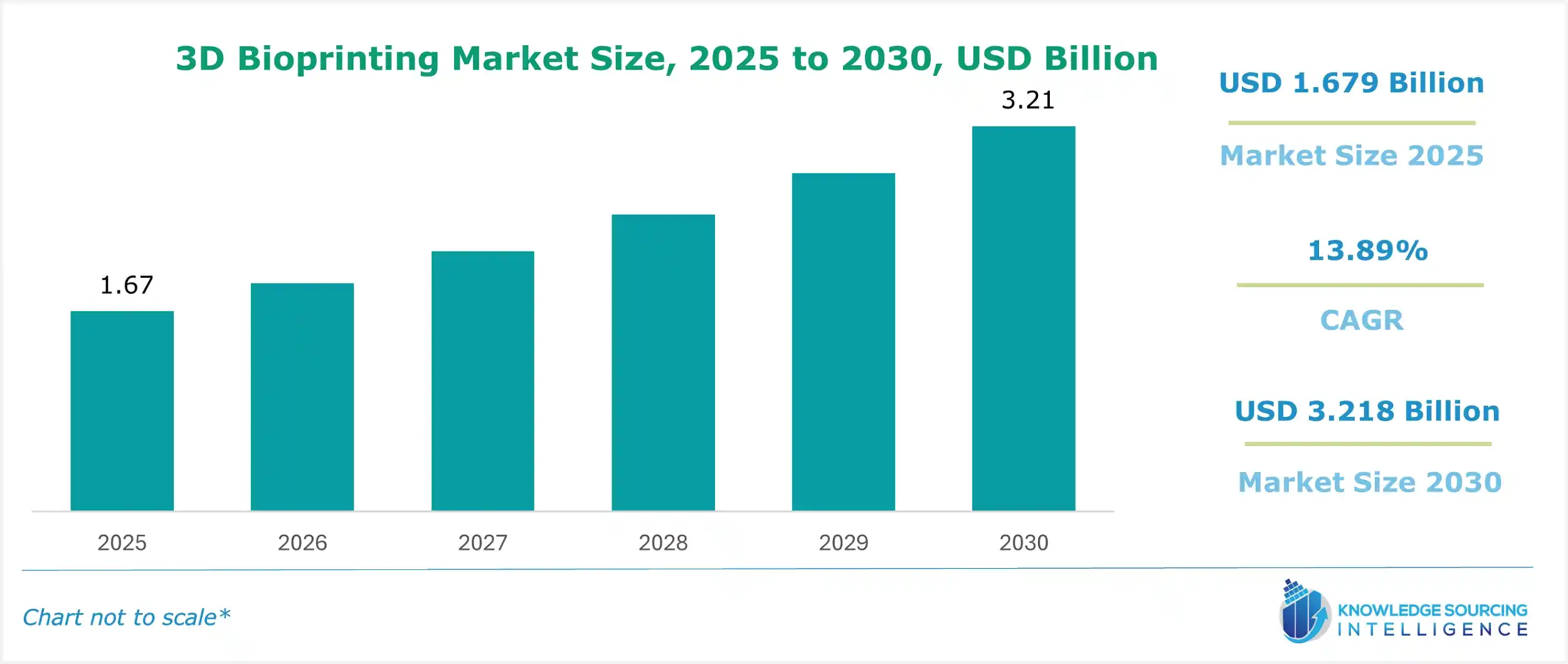
3D Bioprinting Market Size in 2025 | USD 1.679 billion |
3D Bioprinting Market Size in 2030 | USD 3.218 billion |
Growth Rate | CAGR of 13.89% |
Study Period | 2020 to 2030 |
Historical Data | 2020 to 2023 |
Base Year | 2024 |
Forecast Period | 2025 – 2030 |
Forecast Unit (Value) | USD Billion |
Segmentation |
|
Geographical Segmentation | North America, South America, Europe, Middle East and Africa, Asia Pacific |
List of Major Companies in the 3D Bioprinting Market |
|
Customization Scope | Free report customization with purchase |
Segmentation:
By Technology
Inkjet Bioprinting
Laser-Assisted Bioprinting
Extrusion-Based Bioprinting
Magnetic Bioprinting
By Material
Hydrogels
Living Cells
Extracellular Matrices
Biomaterial Inks
By Mode of Application
Tissue And Organ Regeneration
Drug Discovery And Testing
3d Cell Culture
Regenerative Medicine
By End-User
Pharmaceutical And Biotechnology Companies
Research And Academic Institutions
Hospitals And Clinics
Others
By Geography
North America
USA
Canada
Mexico
South America
Brazil
Argentina
Others
Europe
Germany
France
United Kingdom
Spain
Others
Middle East and Africa
Saudi Arabia
UAE
Others
Asia Pacific
China
India
Japan
South Korea
Indonesia
Thailand
Others
Our Best-Performing Industry Reports:
Navigation
Page last updated on: September 12, 2025