Photoresist Chemicals Market expected to reach USD 7.60 billion by 2031
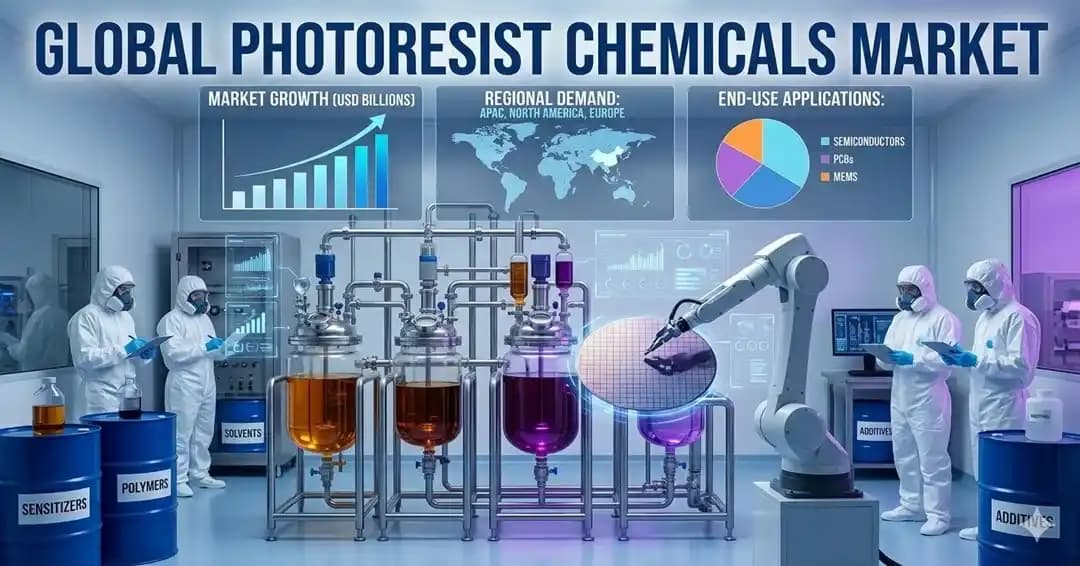
Photoresist Chemicals Market Trends & Forecast
According to a research study published by Knowledge Sourcing Intelligence (KSI), the photoresist chemicals market will expand from USD 5.70 billion in 2026 to USD 7.60 billion in 2031 at a CAGR of 5.9% during the forecast period.
The worldwide photoresist chemicals industry plays a crucial role in the photolithography process, which is at the core of semiconductor fabrication and the manufacture of advanced semiconductor devices. As semiconductor manufacturers move toward smaller feature sizes to improve performance and integration density, demand for advanced photoresist materials is increasing. These materials require higher purity and tighter performance specifications. As a result, suppliers face rising challenges in material science and chemical engineering.
These rapid advances in lithography requirements are the main factor behind the current market conditions, which are turning photoresists into specialized, high-value process enablers.
Request a free sample copy or view the report summary: Photoresist Chemicals Market Report
Photoresist Chemicals Market Report Highlights
Positive photoresist is the main driver of the volume increase because of higher resolution and improved line-width control, and improved compatibility with advanced semiconductor nodes below 10 nm. As chip manufacturers are accelerating to smaller structures for high-performance computing, AI processors, and 5G chipsets, positive resists provide the resolution required for deep and extreme ultraviolet lithography.
The fastest growth is to be found in EUV photoresist, whose expansion is mainly driven by the worldwide transition to advanced semiconductor nodes of 7nm, 5nm, 3nm, and sub-3nm production. As a result of the use of EUV lithography in the production of the chips of the mass market by such firms as TSMC, Samsung, and Intel, demand has thus increased significantly.
The demand for semiconductor manufacturing is a key driver for overall growth. This is mainly caused by the growing use of photoresist chemicals in the various steps of wafer fabrication in both advanced and legacy nodes. The increasing need for chips powering artificial intelligence, automotive electronics, IoT devices, data centers, and consumer electronics is multiplying the number of photolithography cycles required for each wafer.
The electronics and semiconductor industry is the largest end-user sector, which is primarily influenced by various fast technological changes such as AI computing, 5G/6G communication, electric vehicles, robotics, new models of consumer electronics, and high-speed data processing infrastructure. Each improvement in semiconductor performance demands better photolithography functionalities, and thus, there is a continual need for ultra-pure, ultra-high-resolution photoresist chemicals.
Report Coverage:
Report Metric | Details |
|---|---|
Total Market Size in 2026 | USD 5.70 billion |
Total Market Size in 2031 | USD 7.60 billion |
Growth Rate | 5.9% |
Drivers |
|
Restraints |
|
Geographical Segmentation | North America, South America, Europe, Middle East and Africa, Asia Pacific |
Companies |
|
Photoresist Chemicals Market Growth Drivers and Restraints
Growth Drivers:
Growing Demand for Advanced Semiconductors: Advanced semiconductor manufacturing to support AI chips, 5G infrastructure, edge computing, and high-performance computing (HPC) has been expanding rapidly, which is a major growth driver.
Increasing Adoption of EUV Lithography: The use of Extreme Ultraviolet (EUV) lithography has been extending widely in the whole semiconductor industry, particularly in the field of logic and memory production. Every generation of nodes that are EUV-enabled demands photoresist formulations that are even more high-purity and highly sensitive to EUV radiation.
Restraints:
High Cost and Technical Complexity of EUV Photoresists: EUV resists need very strict performance standards, including high resolution, low line-edge roughness, thermal stability, and defect-free patterning. Due to the complexity of their fabrication and qualification, the costs of production are significantly increased, thus the supply is limited, and the wider usage is delayed.
Volatility in Raw Material Prices: The production of photoresist involves the use of high-quality polymers, solvents, photoactive compounds, and various specialty chemicals. Several of these chemicals are subject to price fluctuations caused by supply chain disruptions and geopolitical tensions, and are heavily dependent on specific regions (Japan, Taiwan) for their supply.
Photoresist Chemicals Market Key Development
Product Launch: In January 2025, Lam Research announced that a leading memory manufacturer selected its Aether™ dry photoresist technology for use in advanced DRAM development.
Expansion: In October 2024, DuPont inaugurated the East Star building at its Sasakami facility in Agano-shi, Niigata, Japan, expanding photoresist production capacity to support global lithography material demand.
Photoresist Chemicals Market Segmentation
Knowledge Sourcing Intelligence has segmented the photoresist chemicals market based on product type, technology, application, end-user industry, and region:
Photoresist Chemicals Market, By Product Type
Positive Photoresist
Negative Photoresist
Others
Photoresist Chemicals Market, By Technology
Deep Ultraviolet (DUV) Photoresist
Extreme Ultraviolet (EUV) Photoresist
Electron Beam (E-beam) Photoresist
X-ray Photoresist
Others
Photoresist Chemicals Market, By Application
Semiconductor Manufacturing
Photolithography
Microelectronics & Microelectromechanical Systems
Printed Circuit Boards (PCBs)
Flat Panel Displays & Optoelectronics
Solar Cells
Others
Photoresist Chemicals Market, By End-User Industry
Electronics & Semiconductor Industry
Automotive Industry
Healthcare & Medical Devices
Aerospace & Defense
Consumer Electronics
Others
Photoresist Chemicals Market, By Region
North America
USA
Canada
Mexico
Europe
UK
Germany
France
Italy
Others
Asia Pacific
China
India
Japan
South Korea
Taiwan
Others
South America
Brazil
Argentina
Others
Middle East and Africa (MEA)
Saudi Arabia
UAE
Others
Photoresist Chemicals Market Key Players
Tokyo Ohka Kogyo Co., Ltd.
FUJIFILM Holdings Corporation
JSR Corporation
Shin-Etsu Chemical Co., Ltd.
Sumitomo Chemical Co., Ltd.
Dow Inc.
DuPont de Nemours, Inc.
ALLRESIST GmbH
Asahi Kasei Corporation
Microchemicals GmbH
Avantor Performance Materials, Inc.
Merck KGaA
Get in Touch
Interested in this topic? Contact our analysts for more details.
Latest Press Releases
Ion Exchange Resins Market expected to reach USD 2.80 billion by 2031
Mar 12, 2026
Non-woven Tape Market expected to reach USD 5.7 billion by 2031
Mar 11, 2026
Food and Beverages Anti-Counterfeit Packaging Market expected to reach USD 100.9 billion by 2030
Mar 10, 2026
Cocoa Butter Equivalent Market expected to reach USD 2,004.9 million by 2030
Feb 25, 2026