
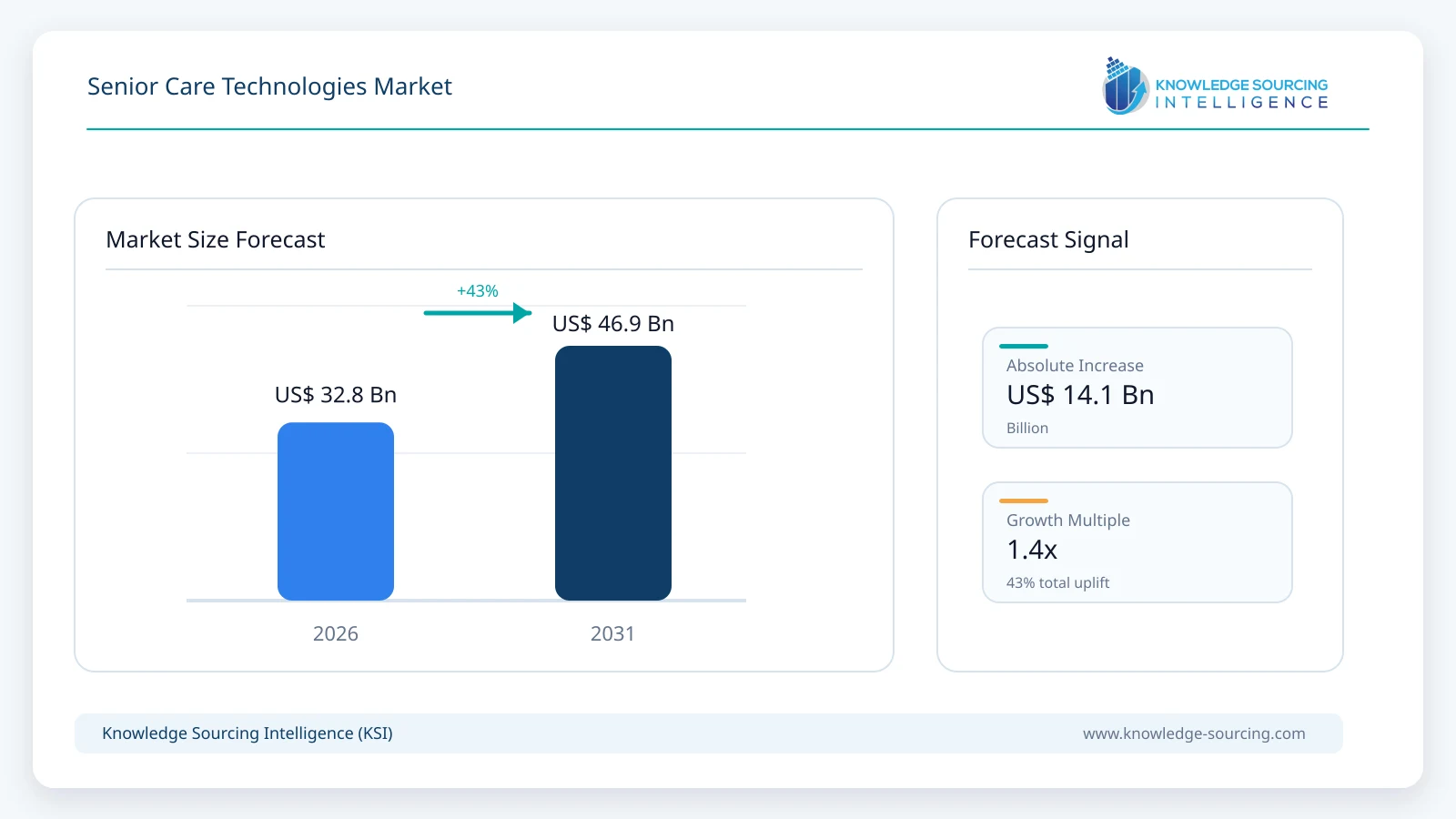
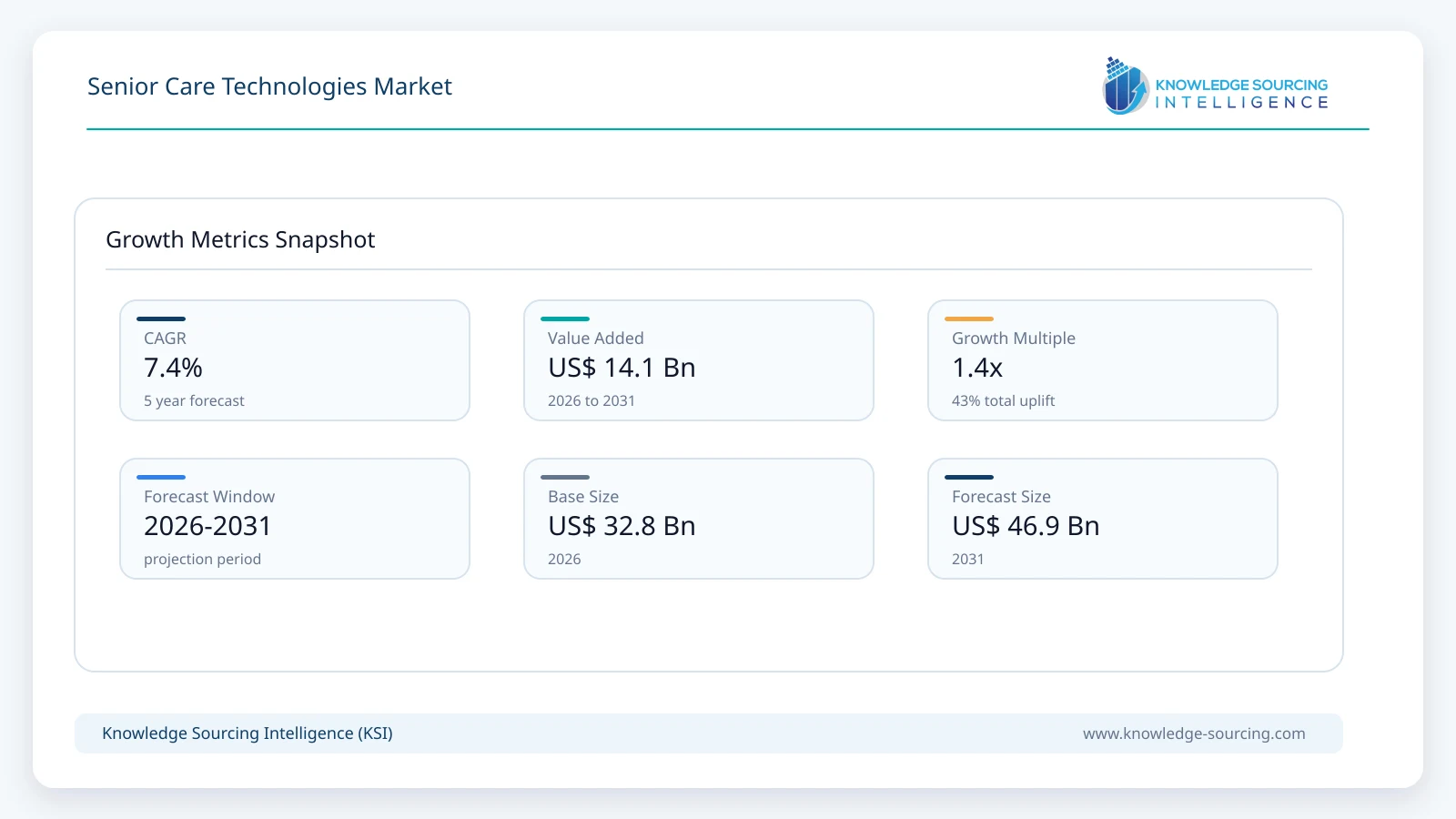
The senior care technologies market is forecast to grow at a CAGR of 7.4%, reaching USD 46.9 billion in 2031 from USD 32.8 billion in 2026.
Highlights:
- 1Remote health monitoring systems account for approximately 23% of the global market in 2026, the largest product category.
- 2Home care services represent approximately 35% of market value in 2026, supported by ageing-in-place and community-based care.
- 3Chronic disease management accounts for approximately 31% of demand by application in 2026, ahead of emergency detection and response.
- 4Home care settings hold approximately 39% of market value in 2026, reflecting the shift of monitoring and care delivery outside institutions.
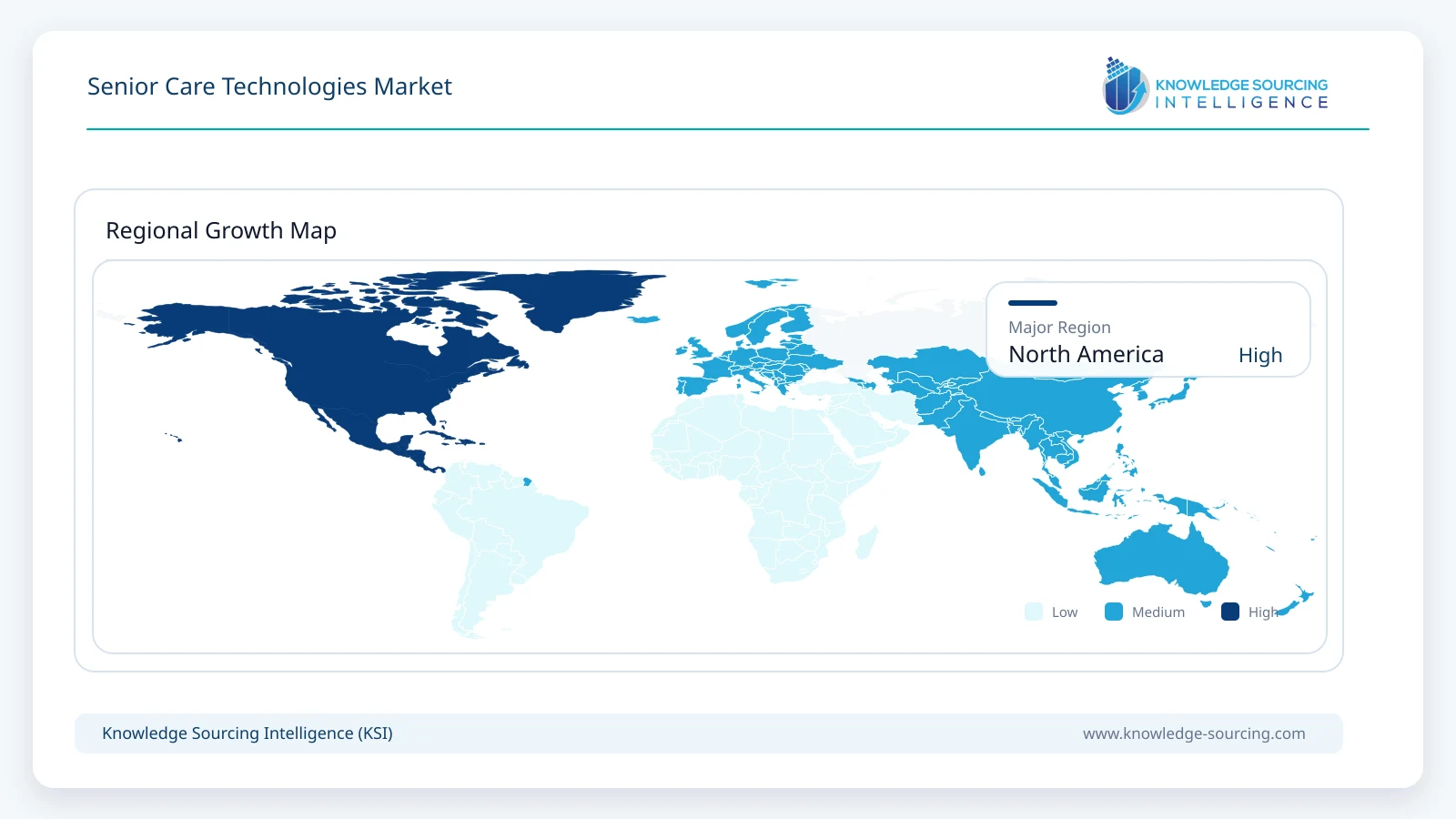
- 5North America accounts for approximately 40% of the global market in 2026, supported by reimbursement, digital-health adoption and senior-care spending.
Market Overview
Senior care technologies include connected monitoring, personal emergency response, fall detection, medication support, telehealth, smart-home sensing and care-management platforms used across homes, senior living communities and healthcare settings. The market is moving away from single-purpose devices toward connected platforms that combine data with care plans and caregiver workflows. Demographics provide a durable demand base: the World Health Organization expects the population aged 60 years and older to increase from 1.0 billion in 2020 to 1.4 billion by 2030 and 2.1 billion by 2050, while the population aged 80 years and above is projected to reach 426 million. This growth is increasing demand at the same time that many health and social-care systems face staffing constraints.
The commercial opportunity is strongest where technology helps older adults remain safely at home or reduces the intensity of institutional care. AARP reports that 75% of U.S. adults aged 50 and above want to remain in their current homes as they age, while 73% want to remain in their communities. This supports remote monitoring, emergency response, passive sensors, and caregiver applications. Senior living facilities have a different requirement: better visibility into falls, wandering, health changes and staff workload. Senior care technology therefore increasingly connects healthcare, social care and housing rather than remaining a narrow medical-device category.
Market Trends
• Passive and Ambient Monitoring Is Reducing Dependence on Wearables
Senior monitoring is shifting from devices that require the user to press a button or remember a wearable toward passive systems that observe motion, room presence and changes in normal activity. Radar-based products such as Vayyar Care provide contact-free fall detection without cameras, while senior-living platforms increasingly combine wearables with room sensing and location data. Passive monitoring is valuable for people with cognitive decline and for users who may not consistently wear or activate a device. It also creates longitudinal information that can identify deviations in routine before an emergency occurs.
• Senior Care Platforms Are Moving From Alerts to Predictive Workflows
Artificial intelligence is increasingly used to interpret data generated by connected senior-care devices. CarePredict analyzes activity patterns for changes that may indicate deterioration, while Tunstall is developing predictive-care approaches using connected-care data. The commercial value is moving beyond whether an alert was triggered toward whether the platform can help staff identify who needs attention first. Predictive analytics are therefore being integrated with care plans, location, fall management and remote vital signs, creating a broader software layer above individual devices.
• Care-at-Home Platforms Are Converging With Senior-Care Technology
Remote patient monitoring and care-at-home infrastructure increasingly overlap with senior-care technology because older adults account for a large share of chronic disease and post-acute monitoring. Best Buy Health combines Current Health remote monitoring with Lively personal emergency response services, while Health Recovery Solutions supports biometric monitoring, medication reminders and video communication. CMS continues Medicare telehealth coverage and added remote therapeutic monitoring codes for 2026. These pathways expand the market beyond private-pay senior devices by embedding technology within health-system care-at-home programs.
Segment Analysis
• By Product Type: Remote Health Monitoring Systems
Remote health monitoring systems account for approximately 23% of the market in 2026, making them the largest product category. Demand is supported by cardiovascular disease, diabetes, respiratory conditions and other chronic illnesses common among older adults. Connected blood-pressure monitors, pulse oximeters, scales and wearables feed centralized platforms that can flag abnormal readings for review. The category also benefits from convergence with telehealth, while fall detection, smart-home sensing and assistive technologies remain important adjacent product groups.
• By Service Type: Home Care Services
Home care services represent approximately 35% of market value in 2026, reflecting the preference of many older adults to remain outside institutions for as long as practical. Technology extends supervision beyond scheduled visits through emergency response, medication reminders, passive sensors and remote vital-sign monitoring. Assisted living is the next major service category because facilities can deploy systems across multiple residents and integrate them with nurse call, location, care-plan and workforce systems.
• By Application: Chronic Disease Management
Chronic disease management accounts for approximately 31% of demand by application in 2026. Older adults frequently manage several conditions simultaneously, making regular measurement, medication adherence and escalation protocols central to care delivery. Remote monitoring can combine biometric data, symptom surveys and virtual consultation. Emergency detection remains another major application: the U.S. CDC reports that more than 14 million adults aged 65 and above fall each year, generating about 3 million emergency-department visits and 1 million hospitalizations.
• By End User: Home Care Settings
Home care settings account for approximately 39% of market value in 2026 as monitoring and support increasingly move to the individual. Adoption includes emergency response, remote patient monitoring, medication support, smart-home sensors and caregiver communication. Senior living facilities form the next major end-user group and typically purchase more integrated systems covering resident safety, staff workflows and care documentation. Hospitals participate mainly through remote monitoring and transitional-care programs.
Market Drivers
• Rapid Population Ageing Is Expanding the Care Requirement
The global number of older adults is increasing faster than the capacity of many conventional care systems. WHO expects one in six people worldwide to be aged 60 years or older by 2030, with this population reaching 1.4 billion. By 2050, the total is projected at 2.1 billion and around 80% of older people are expected to live in low- and middle-income countries. This expands demand for scalable monitoring and support that can operate across home, community and facility settings without requiring equivalent growth in institutional capacity.
• Ageing in Place Is Increasing Demand for Remote and Safety Technologies
Older adults consistently prefer to remain in familiar homes and communities, creating direct demand for technologies that reduce the risks of living with limited supervision. AARP's 2024 survey found that 75% of adults aged 50 and above want to stay in their current homes. Fall detection, personal emergency response, smart-home sensing and medication support address immediate safety needs, while remote monitoring helps manage chronic conditions without frequent travel to clinical facilities.
• Caregiver Shortages Are Increasing the Value of Automation and Prioritization
Caregiver shortages increase the value of systems that automate observation and help prioritize attention. Senior-living and home-care providers need to identify which residents require intervention without increasing staff at the same rate as care demand. Tunstall supports more than five million connected users globally, while CarePredict reports deployment across more than 150 senior-living communities. Demand therefore favors platforms that fit existing care workflows and reduce alarm burden rather than standalone devices that create additional monitoring tasks.
Market Restraints
• Digital Usability and Trust Remain Critical Adoption Barriers
Senior-care technology must serve users with widely different levels of physical ability, cognitive function and digital familiarity. Charging requirements, small interfaces and complex applications can reduce adherence among the users who need monitoring most, while camera-based systems can face privacy resistance. Suppliers are responding with passive sensing, simplified interfaces and caregiver-managed applications, but real-world adoption still depends heavily on whether the technology feels supportive rather than intrusive.
• Fragmented Funding and Interoperability Limit Scale
Payment models differ between medical remote monitoring, social care, private-pay senior living and consumer safety products. A useful technology can still struggle to scale when responsibility for the subscription, monitoring center or caregiver response is unclear. Interoperability is a second barrier because facilities and health systems use multiple EHR, nurse-call and care-management platforms. Vendors are therefore investing in APIs and platform consolidation so new technology reduces rather than adds to staff workload.
Regional Outlook
• North America
North America accounts for approximately 40% of the global market in 2026, led by the United States. The region combines high healthcare spending, established senior-living infrastructure, Medicare-supported telehealth and remote-monitoring pathways, and a large private-pay market for emergency response and home-care technology. It is also home to companies including CarePredict, Health Recovery Solutions, Best Buy Health and ALIS. Asia Pacific is expected to grow faster through 2031 as Japan, China and other markets confront rapid population ageing and seek more scalable home- and community-care models.
Competitive Landscape
Competition spans medical-device companies, remote-care platforms, senior-living software providers and specialized connected-care vendors. Philips, Medtronic and Omron participate through clinical monitoring, while Tunstall combines telecare devices, response centers and managed services. Best Buy Health links Lively senior safety services with Current Health remote monitoring. CarePredict and Vayyar focus on senior-living safety and predictive care, while Health Recovery Solutions and Biofourmis compete in clinical remote monitoring. Platform integration and acquisition are becoming important because providers increasingly want fewer systems covering monitoring, safety and care workflow.
Recent Developments
August 2026: ALIS acquired the Ella and elbi technology platforms to add AI-enabled dementia and behavioral-care guidance to its senior-living software platform.
April 2026: Arlo Technologies acquired Aloe Care Health, extending its subscription platform into AI-powered medical alert, fall prevention and ageing-in-place services.
March 2026: Health Recovery Solutions acquired Rimidi to expand its remote-care capabilities and chronic-disease management platform.
January 2026: Vayyar reported an Essex County deployment of more than 316 4D imaging sensors across care homes, sheltered accommodation, and private homes for fall detection.
October 2025: CarePredict and KamiCare announced an integration combining wearable and vision-based fall alerts within a single senior-living care platform.
Market Outlook
The senior care technologies market is expected to expand steadily through 2031 as demographic ageing increases the number of people requiring support while health systems and families seek to delay institutional care. Remote monitoring, fall detection, medication support and smart-home sensing are becoming components of larger platforms that combine analytics, communication and workflow management. Home care remains the largest service and end-user opportunity, while senior living provides an important enterprise market for integrated safety and staff-productivity systems. North America retains the largest regional position, but Asia Pacific should gain share. The market is forecast to increase from USD 32.8 billion in 2026 to USD 46.9 billion by 2031 at a CAGR of 7.4%.
Senior Care Technologies Market Scope:
| Report Metric | Details |
|---|---|
| Total Market Size in 2026 | USD 32.8 billion |
| Total Market Size in 2031 | USD 46.9 billion |
| Forecast Unit | Billion |
| Growth Rate | 7.4% |
| Study Period | 2021 to 2031 |
| Historical Data | 2021 to 2024 |
| Base Year | 2025 |
| Forecast Period | 2026 – 2031 |
| Segmentation | Product Type, Service Type, Application, End-User |
| Companies |
|
Market Segmentation
By Product Type
Safety & Security System
Fall Detection & Prevention System
Remote Health Monitoring System
Medication Management System
Socialization and Mental Stimulation System
Telehealthcare System
Assistive Robotics & Cobots
Smart Home & Ambient Sensing Systems
Others
By Service Type
Home Care Service
Assisted Living Service
Skilled Nursing Service
Memory Care Service
Rehabilitation Service
Palliative and Hospice Care Service
Concierge & Lifestyle Management Service
Others
By Application
Emergency Detection & Response
Chronic Disease Management
Predictive Risk Analytics
Cognitive & Mental Health Support
ADL Assistance
Care Coordination & Facility Management
By End User
Home Care Settings
Senior Living Facilities
Hospitals and Clinics
Rehabilitation Centers
Long-Term Care Centers
Others
By Geography
North America
United States
Canada
Mexico
South America
Brazil
Argentina
Others
Europe
United Kingdom
Germany
Spain
France
Italy
Others
Middle East and Africa
Saudi Arabia
South Africa
UAE
Others
Asia Pacific
China
Japan
India
Thailand
Singapore
Taiwan
Indonesia
South Korea
Others
Table of Contents
1. INTRODUCTION
1.1. Market Overview
1.2. Market Definition
1.3. Scope of the Study
1.4. Market Segmentation
1.5. Currency
1.6. Assumptions
1.7. Base and Forecast Years
1.8. Key Benefits to Stakeholders
2. RESEARCH METHODOLOGY
2.1. Research Design
2.2. Secondary Research
2.3. Primary Research
2.4. Market Estimation
2.5. Segment Modelling
2.6. Data Triangulation and Validation
3. EXECUTIVE SUMMARY
3.1. Key Findings
20313.3. Product Type Outlook
3.4. Service Type Outlook
3.5. Application Outlook
3.6. End-User Outlook
3.7. Regional Opportunity Summary
3.8. Analyst View
4. MARKET DYNAMICS
4.1. Market Drivers
4.1.1. Rapid Growth in the Global Older Population
4.1.2. Expansion of Ageing-in-Place and Home-Based Care
4.1.3. Caregiver Shortages and Need for Workforce Productivity
4.1.4. Growth in Chronic Disease Remote Monitoring
4.2. Market Restraints
4.2.1. Digital Usability and User-Adoption Barriers
4.2.2. Privacy and Data-Security Requirements
4.2.3. Fragmented Reimbursement and Funding Models
4.2.4. Interoperability Across Health and Social-Care Systems
4.3. Market Opportunities
4.4. Porter’s Five Forces Analysis
4.5. Industry Value Chain Analysis
4.6. Reimbursement and Policy Environment
4.7. Strategic Recommendations
5. TECHNOLOGICAL OUTLOOK
5.1. AI and Predictive Analytics
5.2. Passive and Ambient Sensing
5.3. Remote Patient Monitoring
5.4. Fall Detection and Prevention Technologies
5.5. Smart Home and Voice Interfaces
5.6. Assistive Robotics and Cobots
5.7. Caregiver and Family Engagement Platforms
6. SENIOR CARE TECHNOLOGIES MARKET BY PRODUCT TYPE
6.1. Introduction
6.2. Safety & Security System
6.3. Fall Detection & Prevention System
6.4. Remote Health Monitoring System
6.5. Medication Management System
6.6. Socialization and Mental Stimulation System
6.7. Telehealthcare System
6.8. Assistive Robotics & Cobots
6.9. Smart Home & Ambient Sensing Systems
6.10. Others
7. SENIOR CARE TECHNOLOGIES MARKET BY SERVICE TYPE
7.1. Introduction
7.2. Home Care Service
7.3. Assisted Living Service
7.4. Skilled Nursing Service
7.5. Memory Care Service
7.6. Rehabilitation Service
7.7. Palliative and Hospice Care Service
7.8. Concierge & Lifestyle Management Service
7.9. Others
8. SENIOR CARE TECHNOLOGIES MARKET BY APPLICATION
8.1. Introduction
8.2. Emergency Detection & Response
8.3. Chronic Disease Management
8.4. Predictive Risk Analytics
8.5. Cognitive & Mental Health Support
8.6. ADL Assistance
8.7. Care Coordination & Facility Management
9. SENIOR CARE TECHNOLOGIES MARKET BY END USER
9.1. Introduction
9.2. Home Care Settings
9.3. Senior Living Facilities
9.4. Hospitals and Clinics
9.5. Rehabilitation Centers
9.6. Long-Term Care Centers
9.7. Others
10. SENIOR CARE TECHNOLOGIES MARKET BY GEOGRAPHY
10.1. North America
10.1.1. By Product Type
10.1.2. By Service Type
10.1.3. By Application
10.1.4. By End User
10.1.5. By Country
10.1.5.1. United States
10.1.5.2. Canada
10.1.5.3. Mexico
10.2. South America
10.2.1. Brazil
10.2.2. Argentina
10.2.3. Others
10.3. Europe
10.3.1. United Kingdom
10.3.2. Germany
10.3.3. Spain
10.3.4. France
10.3.5. Italy
10.3.6. Others
10.4. Middle East and Africa
10.4.1. Saudi Arabia
10.4.2. South Africa
10.4.3. UAE
10.4.4. Others
10.5. Asia Pacific
10.5.1. China
10.5.2. Japan
10.5.3. India
10.5.4. Thailand
10.5.5. Singapore
10.5.6. Taiwan
10.5.7. Indonesia
10.5.8. South Korea
10.5.9. Others
11. COMPETITIVE ENVIRONMENT AND ANALYSIS
11.1. Major Players and Strategy Analysis
11.2. Remote Monitoring and Telehealth Positioning
11.3. Fall Detection and Safety Technology Positioning
11.4. Senior-Living Platform Integration
11.5. AI and Predictive-Care Capabilities
11.6. Home-Care and Ageing-in-Place Ecosystems
11.7. Partnerships, Acquisitions and Platform Consolidation
11.8. Competitive Dashboard
12. COMPANY PROFILES
12.1. Koninklijke Philips N.V.
12.2. Medtronic plc
12.3. OMRON Healthcare Co., Ltd.
12.4. Tunstall Healthcare Group Ltd.
12.5. CarePredict, Inc.
12.6. Best Buy Health
12.7. Health Recovery Solutions
12.8. Biofourmis, Inc.
12.9. Vayyar Imaging Ltd.
12.10. Essence SmartCare
12.11. GrandCare Systems LLC
12.12. ALIS (Medtelligent, Inc.)
13. APPENDIX
Research Methodology
The market is analyzed using a combination of top-down and bottom-up approaches. The top-down assessment reviews ageing demographics, healthcare and social-care expenditure, remote monitoring adoption, senior-living infrastructure, reimbursement pathways and the installed base of connected-care technologies across major countries. The bottom-up assessment evaluates vendor revenue exposure, device and platform penetration, service subscriptions, facility deployments and adoption across home care, senior living, hospitals and long-term care. Segment estimates are reconciled to the accepted global market total, with separate assumptions for product type, service type, application, end user and geography. External evidence from government agencies, healthcare authorities, company filings, provider announcements and industry associations is used to validate adoption rates, demographic drivers and technology transitions. The forecast does not extend the headline CAGR mechanically across individual segments; relative growth is adjusted for reimbursement, care-setting migration, technology maturity, ageing intensity, digital-health adoption and country-level care models.
Navigate
Trusted by the world's leading organizations











