Report Overview
Semiconductor Radiation Detector Market Highlights
Semiconductor Radiation Detector Market Size:
Semiconductor Radiation Detector Market is forecasted to rise at a 4.95% CAGR, reaching USD 416.454 million in 2031 from USD 311.707 million in 2025.
Semiconductor Radiation Detector Market Key Highlights:
In terms of market share, the semiconductor radiation detector market holds a significant portion of the overall radiation detection market. The increasing adoption of these detectors across various sectors contributes to their market share growth. Additionally, with the expanding application areas and technological advancements, the market is expected to capture a larger market share during the forecast period.
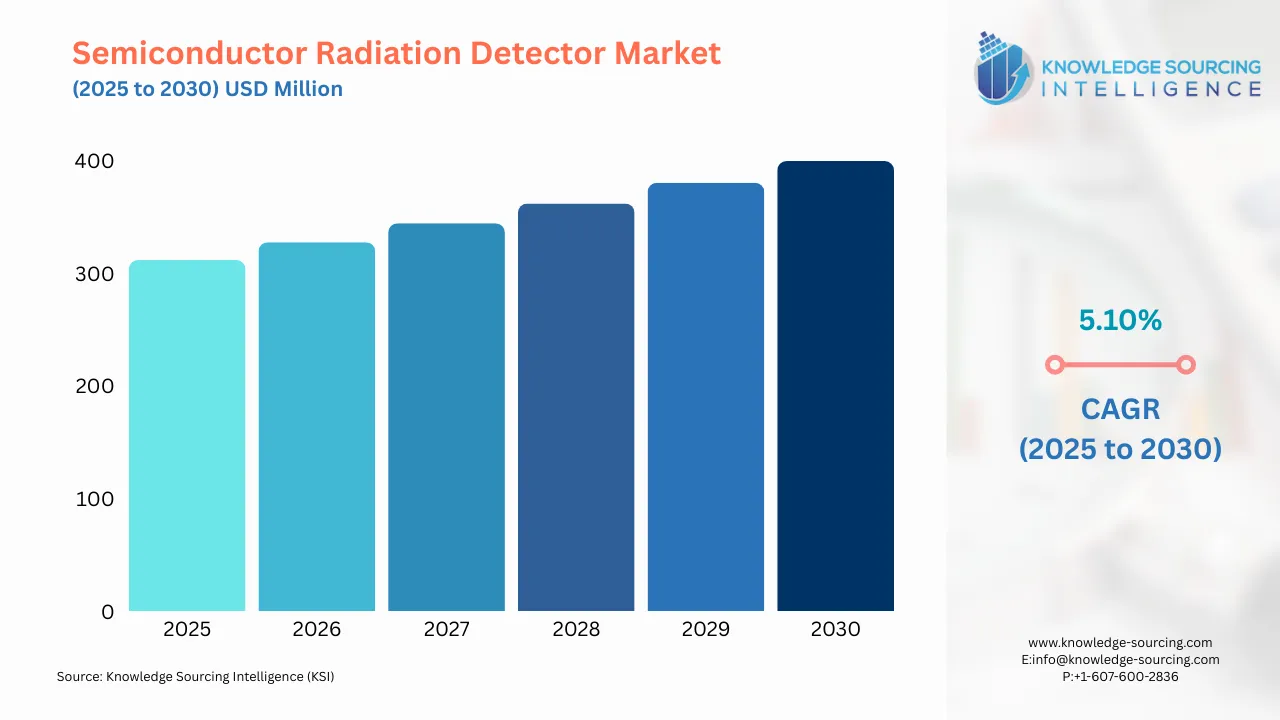
Semiconductor Radiation Detector Market Outlook:
The market forecast for semiconductor radiation detectors indicates a promising outlook that reflects the positive trajectory of the market, showcasing its potential for significant expansion. The anticipated market growth is driven by factors such as the growing emphasis on radiation safety, stringent regulatory standards, and the need for accurate and reliable radiation detection solutions. Additionally, advancements in semiconductor technology, such as the development of high-performance and cost-effective detectors, are expected to contribute to the market's forecasted growth.
Semiconductor Radiation Detector Market Growth Drivers:
Increasing emphasis on safety
The increasing emphasis on radiation safety is a significant driver for the semiconductor radiation detector market. Strict regulations and standards implemented by governments and regulatory bodies across various industries require accurate radiation detection devices to monitor radiation levels and protect workers and the public. Semiconductor radiation detectors are crucial in healthcare applications, ensuring patient and staff safety during medical procedures.
They are also essential for occupational safety in industries with radiation exposure risks. Environmental monitoring agencies rely on semiconductor radiation detectors to assess radiation hazards and maintain a healthy environment. Furthermore, these detectors enhance public safety and security by detecting and preventing the illicit transportation of radioactive materials. With the rising focus on radiation safety, the semiconductor radiation detectors is expected to grow steadily.
Rise in nuclear medicine and radiation therapy.
The nuclear medicine and radiation therapy field is expanding, driven by advancements in medical technology and increasing awareness of the benefits of these treatments. Semiconductor radiation detectors are crucial in accurately measuring radiation doses and monitoring patient safety during nuclear medicine procedures and radiation therapy. The growing demand for these medical procedures directly translates into a higher need for semiconductor radiation detectors, driving the market growth.
Market Challenges:
While the semiconductor radiation detector market shows promising growth potential, it also faces certain restraints. One of the primary challenges is the high cost associated with advanced detectors, which limits their affordability for some end-users. Moreover, these detectors' complex design and manufacturing process pose technical challenges and require skilled expertise. Additionally, the market is subject to stringent regulatory standards and certifications, affecting product development and market entry for new players.
Semiconductor Radiation Detector Market Segment Analysis:
Positive growth in the silicon detector segment.
Silicon detectors account for a substantial share of the overall market, owing to their widespread use and well-established performance characteristics. These detectors offer several advantages, including high sensitivity, excellent energy resolution, and reliable performance in various radiation detection applications. The demand for silicon detectors is driven by their extensive utilization in medical imaging, nuclear power plants, environmental monitoring, and scientific research.
Furthermore, silicon detectors find applications in high-energy physics experiments, where their precision and durability are crucial for detecting and analyzing particle interactions. The growing investments in research and development activities in this field contribute to the increasing adoption of silicon detectors. As the demand for radiation detection solutions continues to rise across various industries, silicon detectors are expected to maintain their prominent position in the semiconductor radiation detector market.
Semiconductor Radiation Detector Market Geographical Outlook:
Based on geography, the semiconductor radiation detector market is segmented into North America, South America, Europe, the Middle East and Africa, and Asia Pacific. In North America, the semiconductor radiation detector market is driven by several factors. The region has a well-established healthcare infrastructure and a strong focus on medical imaging and diagnostics. Semiconductor radiation detectors play a crucial role in medical applications such as X-ray imaging, CT scans, and nuclear medicine, contributing to market growth.
The region also places significant emphasis on homeland security and nuclear safety. Semiconductor radiation detectors are utilized in border control, cargo screening, and nuclear facility monitoring to detect and prevent the illicit smuggling of radioactive materials. The stringent regulations and security measures drive the adoption of semiconductor radiation detectors in these applications.
Technological advancements in emerging nations
The Asia Pacific region is experiencing substantial semiconductor radiation detector market growth. Countries such as China, Japan, and South Korea are at the forefront of technological advancements and have a high demand for radiation detection solutions in various industries. Asia Pacific countries are witnessing a rising demand for medical imaging and diagnostics in the healthcare sector. Semiconductor radiation detectors are extensively used in radiography, fluoroscopy, and molecular imaging applications. The region's increasing population, rising healthcare expenditure, and advancements in healthcare infrastructure contribute to the market growth.
Moreover, the industrial sector in the Asia Pacific, including manufacturing, oil and gas, and mining, requires radiation detectors for occupational safety and radiation monitoring. The region's rapid industrialization, expanding infrastructure, and increasing emphasis on worker safety create opportunities for semiconductor radiation detector manufacturers.
Semiconductor Radiation Detector Market Developments:
August 2025: Kromek received a biosecurity award from the UK Ministry of Defence, along with other orders totaling £860k, to develop novel methods for enhancing biological agent detection.
July 2025: Under the UK Government’s Radiological Nuclear Detection Framework, Kromek secured a £1.7?million contract to supply wearable radiation detectors (D3S?ID) and related services.
May 2025: Kromek secured approximately $900k in orders to supply its D3 series semiconductor detectors to US and European entities, strengthening global nuclear security and non-proliferation efforts.
List of Top Semiconductor Radiation Detector Companies:
Kromek
AMETEK
Hitachi
MIRION
Thermo Fisher
Semiconductor Radiation Detector Market Scope:
| Report Metric | Details |
|---|---|
| Total Market Size in 2026 | USD 311.707 million |
| Total Market Size in 2031 | USD 399.648 million |
| Growth Rate | 5.10% |
| Study Period | 2021 to 2031 |
| Historical Data | 2021 to 2024 |
| Base Year | 2025 |
| Forecast Period | 2026 – 2031 |
| Segmentation | Type, Application, End-User, Geography |
| Geographical Segmentation | North America, South America, Europe, Middle East and Africa, Asia Pacific |
| Companies |
|
Semiconductor Radiation Detector Market Segmentation:
By Type
Silicon Detector
Germanium Detector
CZT Detector
Others
By Application
Physical Research
Industrial Monitoring & Testing
Security Screening
Medical Imaging
Others
By End-User
Manufacturing
Energy & Power
Medical & Healthcare
Military & Defense
Research & Scientific Industry
Others
By Geography
Americas
USA
Europe Middle East and Africa
Germany
United Kingdom
Netherlands
Others
Asia Pacific
China
Japan
South Korea
Taiwan
Others