Report Overview
Semiconductor Front-End Equipment Market Highlights
Semiconductor Front-End Equipment Market Size:
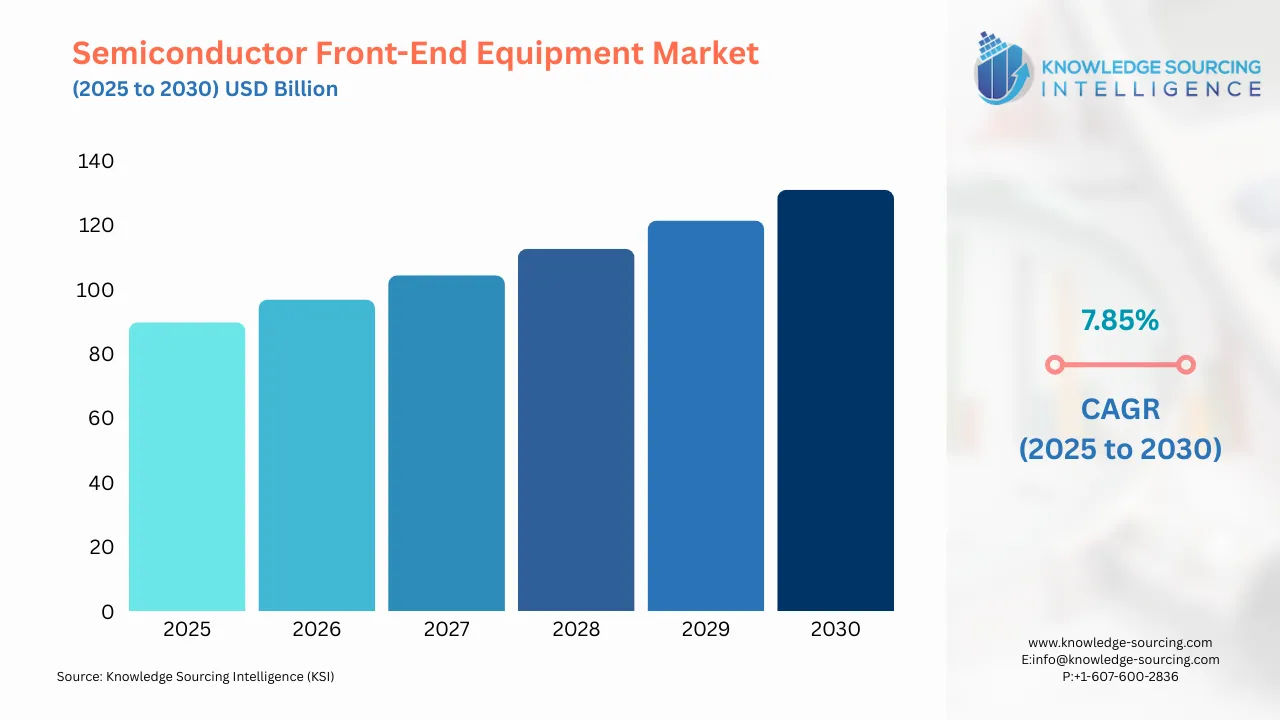
The Semiconductor Front-End Equipment Market is expected to grow from USD 89.743 billion in 2025 to USD 130.945 billion in 2030, at a CAGR of 7.85%.
Semiconductor Front-End Equipment Market Trends:
Semiconductor manufacturing equipment is the apparatus used to create various electrical and integrated circuits (ICs). The most often used semiconductor production equipment is the front end. Front-end equipment includes silicon wafer manufacture, photolithography, deposition, etching, ion implantation, and mechanical polishing. Their many benefits are streamlined production, enhanced output and dependability, decreased design and manufacturing errors, and improved worker safety.
Growing demand for semiconductor fabrication facilities, a thriving semiconductor industry, rising demand for semiconductor components in hybrid and electric vehicles, and soaring demand for AI chips fueled by upcoming workloads and applications driven by AI are the main factors driving the market for semiconductor front-end manufacturing equipment.
Semiconductor Front-end Equipment Market Growth Drivers:
- The market will increase exponentially due to the introduction of new front-end equipment facilities.
According to SEMI's quarterly World Fab Forecast study, global semiconductor equipment investment for front-end facilities is anticipated to increase by 18% YOY to an all-time high of US$107 billion in 2022, marking the third straight year of growth after a 42% increase in 2021. This noteworthy accomplishment is a testament to the persistent drive to increase and enhance capacity to suit a wide range of markets and develop applications, reiterating expectations for long-term industry growth to allow electronics for the digital world. For instance, A deal was reached between Samsung Electronics and ASML in June 2022 to launch EUV lithography equipment and high-numerical-aperture (NA) EUV lithography equipment the following year.
Intel said earlier this year that it had secured a deal to buy five of these pieces of machinery and would use them to start making 1.8-nm chips in 2025. TSMC also said that it would use high-NA EUV lithography equipment in its process for the first time in the world in 2024 at the Silicon Valley Technology Symposium in the United States in June 2022. Compared to current EUV lithography equipment, next-generation high-NA EUV lithography equipment can engrave finer circuits. The outcome of a competitive technological competition in the electronics business is viewed as a game-changer.
Semiconductor Front-end Equipment Market Segment Analysis:
- By equipment type, the wafer fabrication segment will grow significantly over the forecasted period.
An expanding semiconductor industry, a rising need for semiconductor fabrication facilities, and investments in wafer fabrication facilities worldwide are driving the wafer fabrication equipment market for semiconductor front-end production equipment. For instance, Toshiba Electronic Devices & Storage Corporation announced in February 2022 that its main discrete semiconductor production plant would receive a new 300-millimeter wafer fabrication facility for power semiconductors. Toshiba has accelerated the commencement of production on 300-millimeter lines and increased production capacity on 200-millimeter lines to keep up with demand growth. Market trends will be considered when making decisions on the new fab's overall capacity and equipment investment, the start of production, production capacity, and production schedule.
Additionally, in May 2022, Texas Instruments opened new 300-mm semiconductor wafer production facilities in Sherman, Texas. Tens of millions of analog and embedded processing chips used in all types of electronics will be produced daily at the new fabs. The historic investment might generate US$30 billion and up to 3,000 jobs. To accommodate the anticipated increase in semiconductors in electronics, the company's newest 300-millimeter wafer fab began production in September 2022 and will build up over the following months.
Semiconductor Front-end Equipment Market Geographical Outlook
- Investing in semiconductor manufacturing facilities in India will cause Asia Pacific to grow fastest.
Most semiconductor foundries worldwide are located in the Asia-Pacific area, home to well-known firms like TSMC, Samsung Electronics, etc. India's market share in the production of electronic systems has grown dramatically in recent years. The popularity of electronic goods is accelerating due to technological advancements like the introduction of 5G networks and the Internet of Things.
The Ministry of Electronics and Information Technology unveiled the plan for setting up Semiconductor Fabs in India in December 2021 to draw significant investments for setting up semiconductor wafer fabrication facilities within the nation to strengthen the electronics manufacturing ecosystem. Up to 50% of the project's cost is included in the financial help provided. This is being done in keeping with the National Policy on Electronics 2019 (NPE 2019), which aims to establish India as a hub for Electronics System Design and Manufacturing (ESDM) and strengthen the industry's ability to compete internationally. The semiconductor front-end equipment market is predicted to benefit significantly from this.
Semiconductor Front-end Equipment Market Key Developments:
- October 2025: Applied Materials launched the Centura™ Xtera™ Epi system, integrating pre-clean/etch to enable void-free, uniform epitaxial layers for 2nm Gate-All-Around transistors.
- October 2025: Applied Materials also launched its e-beam metrology tool PROVision 10, providing sub-nanometer resolution critical for yield control in complex 3-D logic and memory chips.
- February 2025: Lam Research unveiled Akara®, its most advanced plasma conductor etch tool, offering new precision control for scaling GAA transistors and 3D NAND devices.
List of Top Semiconductor Front-End Equipment Companies:
- Applied Materials Inc
- ASML Holding Semiconductor Company
- Tokyo Electron Limited
- KLA Corporation
- Lam Research Corporation
Semiconductor Front-End Equipment Market Scope:
| Report Metric | Details |
|---|---|
| Study Period | 2021 to 2031 |
| Historical Data | 2021 to 2024 |
| Base Year | 2025 |
| Forecast Period | 2026 – 2031 |
| Report Metric | Details |
| Semiconductor Front-End Equipment Market Size in 2025 | USD 89.743 billion |
| Semiconductor Front-End Equipment Market Size in 2030 | USD 130.945 billion |
| Growth Rate | CAGR of 7.85% |
| Study Period | 2020 to 2030 |
| Historical Data | 2020 to 2023 |
| Base Year | 2024 |
| Forecast Period | 2025 – 2030 |
| Forecast Unit (Value) | USD Billion |
| Segmentation |
|
| Geographical Segmentation | North America, South America, Europe, Middle East and Africa, Asia Pacific |
| List of Major Companies in Semiconductor Front-End Equipment Market |
|
| Customization Scope | Free report customization with purchase |
Semiconductor Front-End Equipment Market Segmentation:
- By Equipment Type
- Lithography Equipment
- Etching Equipment
- Wafer Cleaning Equipment
- Others
- By End-User
- Automotive
- Consumer Electronics
- IT and Communications
- Semiconductor Fabrication Plants
- Others
- By Geography
- North America
- USA
- Canada
- Mexico
- South America
- Brazil
- Argentina
- Others
- Europe
- United Kingdom
- Germany
- France
- Spain
- Others
- Middle East & Africa
- Saudi Arabia
- UAE
- Others
- Asia Pacific
- Japan
- China
- India
- South Korea
- Australia
- Others
- North America