Report Overview
Salmonella Testing and Treatment Highlights
Salmonella Testing and Treatment Market Size:
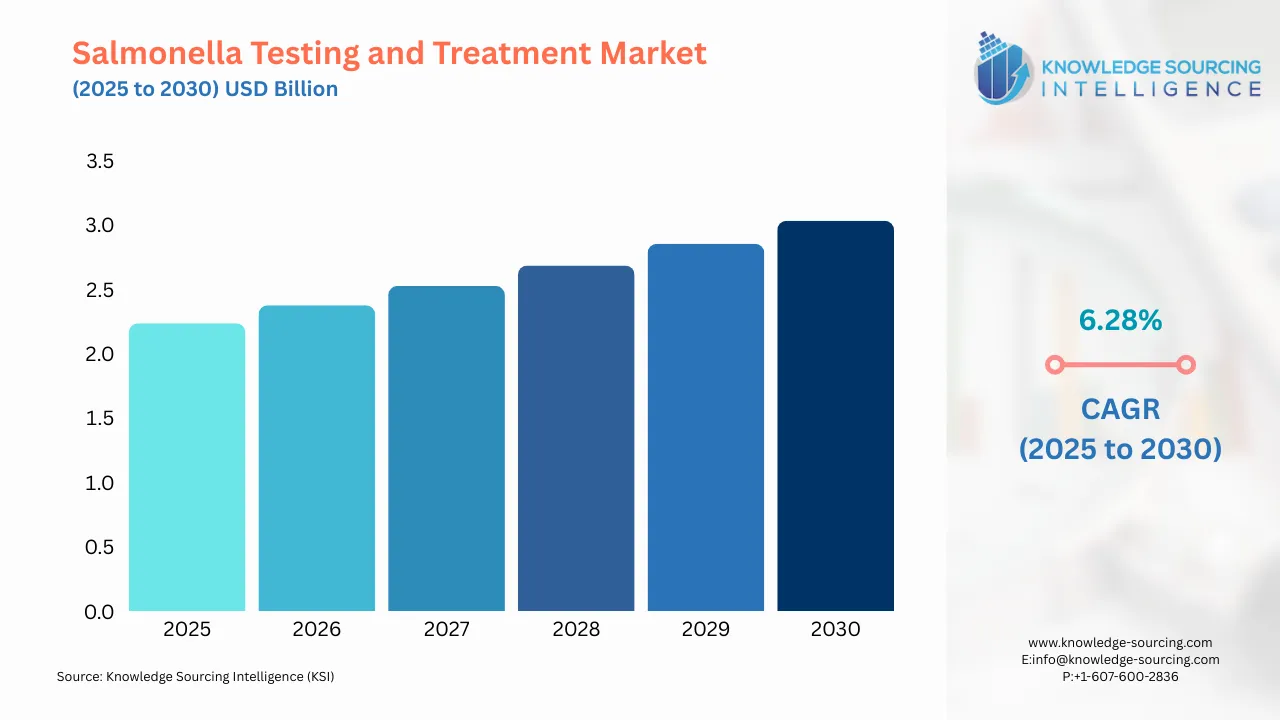
The salmonella testing and treatment market is expected to grow at a CAGR of 6.28%, reaching a market size of US$3.032 billion in 2030 from US$2.236 billion in 2025
Salmonella is a type of bacteria that causes food poisoning and infections in humans and animals. These can affect a wide range of animals, leading to various diseases in poultry, cattle, and pigs. These are primarily transmitted through contaminated food, water, cross-contamination, and surfaces. Thus, the bacteria are also transmitted to humans, causing various diseases in humans and animals, with the most common being foodborne illnesses along with typhoid fever, salmonellosis, paratyphoid fever, salmonella meningitis, and pneumonia.
Food safety is critical for preventing the spread of salmonella disease, as contaminated foods and beverages are the most common way these bacteria transmit. Thus, food products like dairy, processed foods, meats, eggs, etc., need rigorous salmonella testing before being sold to consumers to prevent the spread of salmonella. Testing and diagnosing meats, such as beef and pork, is vital to food safety to avoid salmonella outbreaks, making salmonella testing and treatment essential to protect public health and ensure safe consumption. When individuals are affected by typhoid and paratyphoid, they require diagnostic testing and appropriate treatment, forming a significant part of the salmonella testing and treatment market.
The rising incidences of salmonella outbreaks are causing an increasing number of diseases among people, such as foodborne illnesses and typhoid fever, among others, driving the need for diagnosis and treatment for humans. It is also driving the demand for diagnosis and treatment in animals such as poultry and other animals, as they also spread the disease. The increasing number of salmonella outbreaks is prompting the need to stop the spread and ensure public health safety. This growing concern has led governments to take stricter actions, implementing regulations and investing in testing and treatment solutions, leading to market growth. Further, there is an increasing focus on food safety, as it is critical to preventing the spread of salmonella and its outbreak. Moreover, the advancement in diagnostic techniques for testing and treatment is greatly boosting market growth.
Salmonella Testing and Treatment Market Growth Drivers:
- Rising government regulations necessitating the food manufacturers for salmonella testing
There are increasing government regulations worldwide for food manufacturers for salmonella testing their food products, such as dairy products, processed foods, etc., before being sold to the market. This regulation is increasingly being tightened due to the rising number of salmonella outbreaks, necessitating the government to take stricter regulatory and preventive measures in food and beverage to effectively test food products before they are sold to the public. For instance, the government of the US, through its Food and Drug Administration[1], offers guidelines for the companies that manufacture, process, pack, or hold human foods, highlighting the importance of testing food for salmonella., interpreting test results, and taking appropriate actions if contamination is found and using validated testing methods. This compulsorily makes the food and beverage manufacturers, including the poultry, meat, and beef sellers, do salmonella testing, thus driving the market growth.
- Increasing number of salmonella outbreaks is driving the demand for salmonella testing and treatment
An increasing number of salmonella outbreaks have been witnessed in recent years, primarily due to contamination in poultry, meats, foods, and beverages, which are then transmitted to people. As per the data by the Centers for Disease Control and Prevention, there are 9.4 million cases of foodborne illness, a disease caused by the Salmonella bacteria, and 1,351 deaths due to foodborne illness. Recently, in September 2024, a salmonella outbreak was linked with eggs, leading to 93 cases and 34 hospitalizations across 12 states of the USA. CDC data also highlights that salmonella is the most common known cause of hospitalization due to food poisoning in the United States, with over 19,000 cases per year. This spread is causing significant health issues for individuals and leading to economic losses due to medical costs and reduced productivity. As a result, there has been a rise in government regulations aimed at controlling the outbreak and ensuring food safety. Along with growing consumer awareness about the importance of safe food, the demand for salmonella testing is steadily increasing to prevent contamination and protect public health.
Salmonella Testing and Treatment Market Segment Analysis:
- By Treatment Method, the antibiotics segment will hold the largest market share
By treatment method, the salmonella testing and treatment market is segmented into antibiotic treatment, supportive care, vaccination, and others. During the forecast period, the antibiotic treatment segment will continue dominating the salmonella treatment market share.
This method uses antibiotics to eliminate the Salmonella bacteria from the body. Common antibiotics like Ciprofloxacin, Azithromycin, Ampicillin, and others are used for severe salmonella infections. In normal and mild cases, it is not suggested that antibiotics be used as they contribute to antibiotic resistance. Traditionally, antibiotic treatment holds a larger market share based on treatment methods. There are many reasons behind it, as it has a long track record of being effective in eradicating salmonella infection. It is also an easy and effective way to treat salmonella. Additionally, antibiotic treatments are cost-effective and widely accessible. Further, the lack of more effective alternatives makes it an ideal choice for treatment, and the trend will continue in the anticipated years.
Salmonella Testing and Treatment Market Geographical Outlook:
- Asia-Pacific will be the fastest-growing region during the forecast period
The salmonella testing and treatment market is segmented by geography into North America, South America, Europe, Middle East and Africa, and Asia Pacific regions. During the forecast period, Asia-Pacific will be the fastest-growing region. Meanwhile, North America will continue dominating the market in the coming years. Europe will also have a significant market share in the forecast period.
The Asia Pacific region will be the fastest-growing market during the forecast period. This robust growth in the region is attributed to the growing economies like China, South Korea, and India, which are driving continued healthcare infrastructure development. This is propelling the need for salmonella testing and treatment. The growing food and safety regulations in these Asian countries are also accelerating the market growth. Further, increasing food processing units is leading governments to regulate food safety and standards and raising the need for salmonella testing. The increasing prevalence of neurological disorders is driving the demand for diagnostics, thus propelling market growth.
Meanwhile, North America is estimated to hold a significant market share in salmonella testing and treatment. The region dominates the market as there are high occurrences of foodborne illnesses, strict regulations, and a robust healthcare sector. This dominance is also attributed to the advanced healthcare infrastructure in countries like the United States, driving efficient and effective salmonella treatment.
Salmonella Testing and Treatment Market Recent Developments:
- In April 2024, Neurogen® Corporation launched its new product, Neogen Molecular Detection Assay 2 for Salmonella Enteritidis/Salmonella Typhimurium. This aims to enhance food safety programs by addressing a challenging need in the poultry industry. This overcomes the issue with traditional serology and PCR-based methods with improved accuracy, reduced time for results, and a streamlined workflow.
- In April 2024, Hygiena® received AOAC RI certification for its InSite® Salmonella test device, which is an easy-to-use test for the screening and detection of S. enterica on food contact surfaces and other processing equipment containing stainless steel, plastic, rubber, and ceramic or sealed concrete surfaces after cleaning. It is a self-contained device consisting of a liquid medium formulated with growth enhancers and chromogenic compounds selective for Salmonella species.
List of Top Salmonella Testing and Treatment Companies:
- Thermo Fisher Scientific Inc.
- Merck KGaA
- Gold Standard Diagnostics
- Romer Labs
- BD
Salmonella Testing and Treatment Market Scope:
| Report Metric | Details |
|---|---|
| Study Period | 2021 to 2031 |
| Historical Data | 2021 to 2024 |
| Base Year | 2025 |
| Forecast Period | 2026 – 2031 |
| Report Metric | Details |
| Salmonella Testing and Treatment Market Size in 2025 | US$2.236 billion |
| Salmonella Testing and Treatment Market Size in 2030 | US$3.032 billion |
| Growth Rate | CAGR of 6.28% |
| Study Period | 2020 to 2030 |
| Historical Data | 2020 to 2023 |
| Base Year | 2024 |
| Forecast Period | 2025 – 2030 |
| Forecast Unit (Value) | USD Billion |
| Segmentation |
|
| Geographical Segmentation | North America, South America, Europe, Middle East and Africa, Asia Pacific |
| List of Major Companies in Salmonella Testing and Treatment Market |
|
| Customization Scope | Free report customization with purchase |
Salmonella Testing and Treatment Market is analyzed into the following segments:
- By Testing Method
- Culture-based Methods
- Molecular-based Methods
- Immunoassay
- By Treatment Method
- Antibiotic Treatment
- Supportive Care
- Vaccination
- Others
- By End-User
- Food Industry
- Healthcare
- Agriculture and Animal Husbandry
- Others
- By Geography
- North America
- USA
- Canada
- Mexico
- South America
- Brazil
- Argentina
- Others
- Europe
- United Kingdom
- Germany
- France
- Spain
- Others
- Middle East and Africa
- Saudi Arabia
- UAE
- Others
- Asia Pacific
- China
- Japan
- South Korea
- Australia
- India
- Indonesia
- Thailand
- Others
- North America
Our Best-Performing Industry Reports:
- Blood Pressure Monitoring Devices Market
- Smart Medical Device Market
- Refurbished Medical Equipment Market
Navigation
- Salmonella Testing and Treatment Market Size:
- Salmonella Testing and Treatment Market Key Highlights:
- Salmonella Testing and Treatment Market Growth Drivers:
- Salmonella Testing and Treatment Market Segment Analysis:
- Salmonella Testing and Treatment Market Geographical Outlook:
- Salmonella Testing and Treatment Market Recent Developments:
- List of Top Salmonella Testing and Treatment Companies:
- Salmonella Testing and Treatment Market Scope:
- Our Best-Performing Industry Reports:
Page last updated on: September 12, 2025