Report Overview
Nanotools Market - Strategic Highlights
Nanotools Market Size:
The Nanotools market is expected to grow at a CAGR of 8.99% over the forecast period, reaching a market size of US$31,482.857 million in 2030 from US$20,475.714 million in 2025.
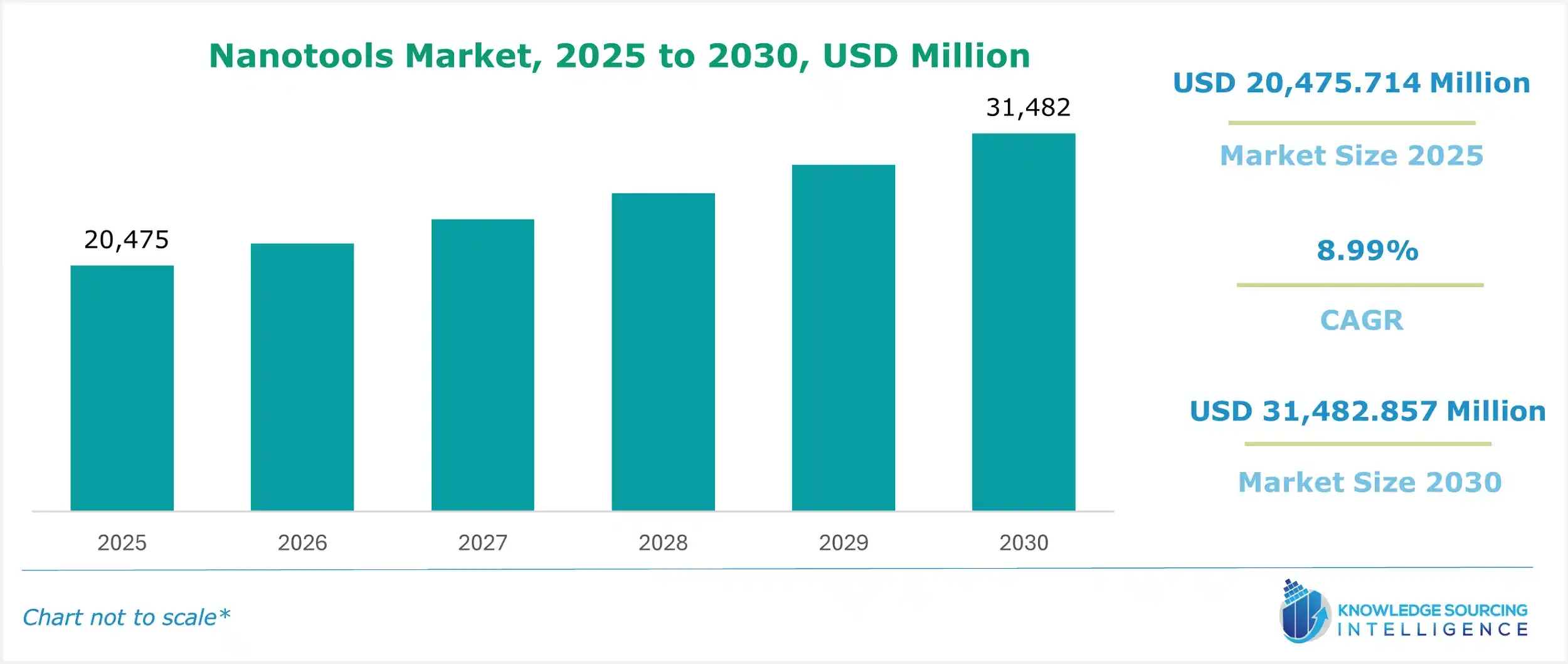
The nanotools market refers to the instruments, devices, and software used for fabricating, measuring, and manipulating materials at the nanoscale. The market covers the use of nanotechnology-based tools in research, manufacturing, and various industrial applications.
The use of nanotools has been increasing in the healthcare sector as they have great potential in diagnosing, treating, and monitoring various diseases, including cancer. This is anticipated to boost the growth of the nanotools market during the forecast period. There has been a significant increase in the demand for minimally invasive surgeries over the years, which is expected to grow further in the coming years, thereby increasing the need for nanotools. Moreover, the growth in the end-use industries, including biotechnology, mining, electronics and semiconductors, and metallurgy, is leading to an increased demand for nanotools. As these industries have advanced, the use of nanotools has become more prominent.
Nanotools Market Drivers:
- Growing demand for minimally invasive surgeries
The demand for minimally invasive surgeries has been increasing, and as nanotools are utilized in them, it is propelling its market growth. According to an article published by the Journal of the Society of Laparoscopic and Robotic Surgeons in US NLM, NIH in 2020, a study conducted in the period from January 2003 to December 2019 in the U.S., an increase in minimally invasive surgeries by general surgery residents was reported. For cholecystectomy, it increased from 88% to 94%; for inguinal hernia repair, 20% to 47%; for appendectomy, 38% to 93%; for colectomy, 8% to 43%; for gastrectomy, 43% to 84%; and for Nissen, 71% to 91%.
Cosmetic procedures are also moving towards the minimally invasive technique, which is expected to augment the nanotools market further during the forecast period. According to the Plastic Surgery Statistics Report by the American Society of Plastic Surgeons, the number of minimally invasive cosmetic procedures for Botulinum Toxin Type A (Botox, Dysport, Xeomin) in the U.S. has increased from 786,911 in 2000 to 4,401,536 in 2020. The total cosmetic minimally invasive procedures reached 15,750,363 in the U.S. in 2020, rising from 4,847,561 in 2000.
- Growing use in the electronics industry
With the advancements in the electronics and semiconductor industry, the use of nanotools has been increasing, which is anticipated to boost the nanotools market expansion. According to data from Japan Electronics and Information Technology (JEITA), the production by the global electronics and IT industries has increased by 9% year on year to $3,703.2 billion in 2024 and 8% year on year to $3,990.9 billion in 2025.
Nanotools Market Geographical Analysis:
- North America and Asia Pacific will constitute the major share
Geographically, the North American region is anticipated to hold a significant market share owing to the rising demand for minimally invasive surgeries, especially in the United States. The region also has a technologically advanced healthcare system. Hence, there is a higher tendency to adopt and expand the use of nanotools in the healthcare sector, contributing to the market share of the North American region. The Asia Pacific region is anticipated to witness substantial growth due to the rising expenditure in the healthcare sector and the increasing use of nanotools in the electronics and semiconductor industry.
Nanotools Market Recent Key Developments:
- Collaboration: In April 2024, Alcyon Photonics and Applied Nanotools collaborated to introduce the Process Design Kit. It aims to streamline the design and manufacturing of integrated photonic devices. This led to the development of photonic integrated circuits, a rapidly growing segment in semiconductors and nanotechnology.
Nanotools Market Scope:
| Report Metric | Details |
|---|---|
| Study Period | 2021 to 2031 |
| Historical Data | 2021 to 2024 |
| Base Year | 2025 |
| Forecast Period | 2026 – 2031 |
| Report Metric | Details |
| Nanotools Market Size in 2025 | US$20,475.714 million |
| Nanotools Market Size in 2030 | US$31,482.857 million |
| Growth Rate | CAGR of 8.99% |
| Study Period | 2020 to 2030 |
| Historical Data | 2020 to 2023 |
| Base Year | 2024 |
| Forecast Period | 2025 – 2030 |
| Forecast Unit (Value) | USD Million |
| Segmentation |
|
| Geographical Segmentation | Americas, Europe, Middle East, and Africa, Asia Pacific |
| List of Major Companies in the Nanotools Market |
|
| Customization Scope | Free report customization with purchase |
Nanotools Market Segmentation:
By Product Type
- Nanolithography
- Microscopes
- Nano-Manipulators
- Nano Machining Tools
- Others
By Application
- Electronics & semiconductors
- Healthcare & Life Sciences
- Material Science and Energy
- Aerospace and Defense
- Others
By End-User Industry
- Electronics and Semiconductor
- Renewable Energy
- Mining
- Metallurgy
- Healthcare
- Biotechnology
- Others
By Region
- Americas
- US
- Europe, Middle East, and Africa
- Germany
- Netherlands
- Others
- Asia Pacific
- China
- Japan
- Taiwan
- South Korea
- Others