Report Overview
Metal Chelates Market - Highlights
Metal Chelates Market Size:
The metal chelates market, sustaining a 7.12% CAGR, is anticipated to reach USD 821.474 million in 2031 from USD 543.720 million in 2025.
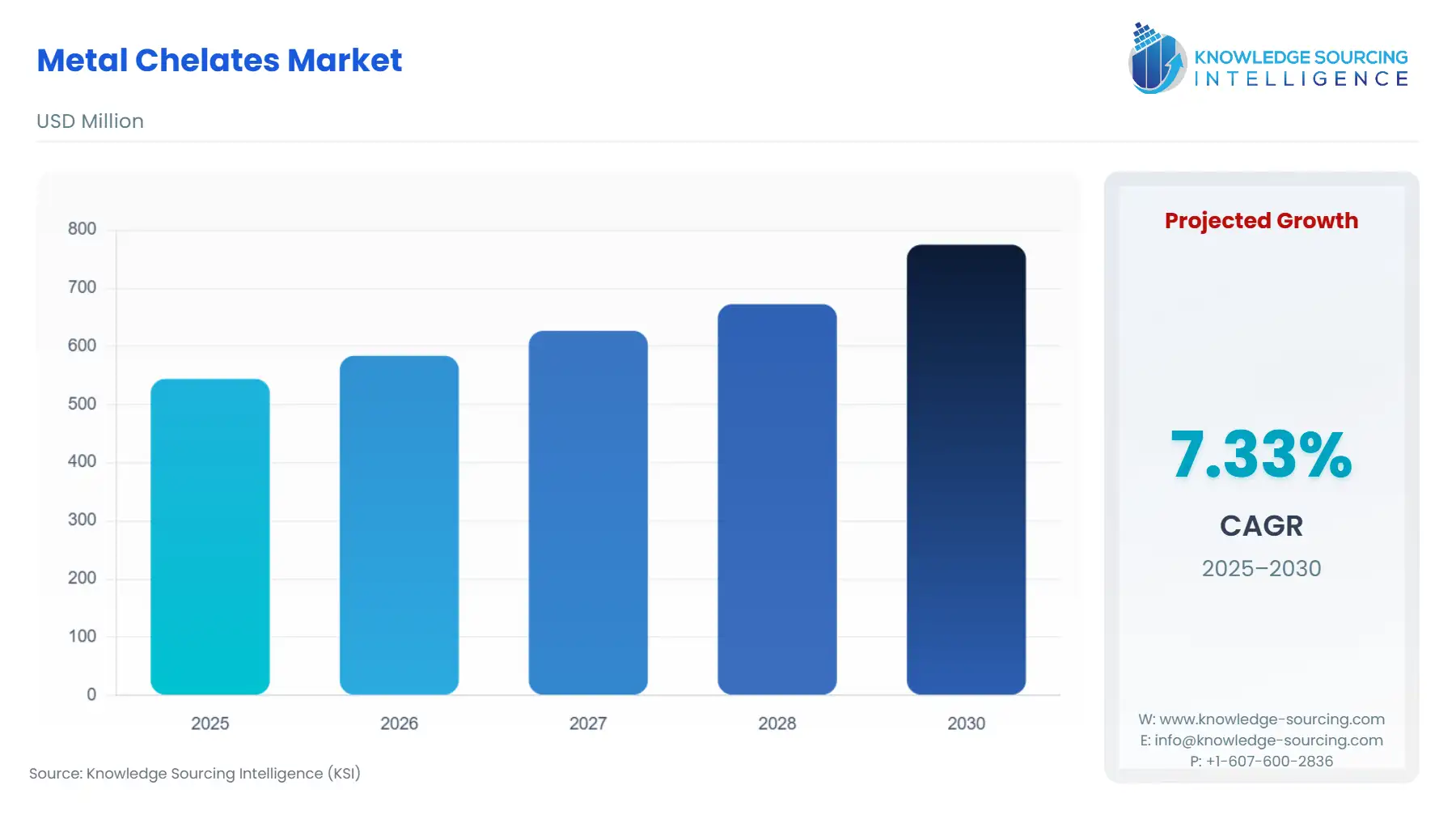
Metal chelates are described as organic chemical compounds that form covalent and iconic bonds with metal elements. Metal chelates are found naturally such as porphyrins and fulvic acid or can be manufactured in a facility like EDTA and phthalocyanines. Metal chelates are mostly used in agriculture, dye & pigment as well as personal care industries. In agriculture, chelated metals are used to speed up the growth of the crop as well as act as fertilizer. A few examples of popular metal ions that go through the chelation process are copper, iron, manganese, and zinc. The market for metal chelates machines is divided into various segments, including product type, crop type, mode of application, and geographical regions.
Metal chelates have applications in several wide ranges of end-user industries as well as laboratories. Chelated metals are used in the products of several products such as dietary supplements, drugs, food products, cosmetics, and personal care products which is driving the growth of the global market. However, agriculture is one of the significant users of chelated metal products. Metal chelates are added to crops to improve respiration, metabolism, energy transmission, nitrogen fixation, and plant growth. The booming population, rising food insecurity, and growing scarcity of fertile farmland and other resources are driving the demand for nutrient-rich, high-yielding crops. Moreover, metal deficiency in plants due to lack of fertile soil is also growing demand for agricultural metal chelates.
However, the availability of low-cost substitutes, growing demand for organic fertilizer, high price, and lack of knowledge about micronutrient deficiency are likely to obstruct the growth of the global market for metal chelates during the projection period. Continuous product innovation, launches, and progress in agriculture technology are providing new opportunities for key market players.
Metal Chelates Market Driver:
Growing population, focus on food security, and scarcity of agricultural resources are factors driving the metal chelates market growth
According to the most current UN estimate, there are 8 billion people on the planet right now, and by 2050 that number might increase to 9.7 billion. Global food demand is increasing as a result of this development and rising income in emerging nations, which affect people's diets by making them consume more meat and vegetables leading to an increase in food demand.
It is predicted that food demand will increase by 59 percent to 98 percent by 2050. In response, farmers around the world will have to expand their farming area or increase productivity on already existing land by using irrigation, fertilizers, and micronutrients like chelated metals.
The production of the desired amount of food crops will also become difficult in the future due to a number of other problems, such as urbanization, climate change, lack of fertile farmland, and investment. Studies have shown that agricultural yields will be significantly impacted over the long term by climate change-related water scarcity, rising global temperatures, and extreme weather. Metal chelates are crucial in agriculture to increase crop yield because they provide micronutrients, which are essential for both plants' and animals' metabolic processes in caressing food supply.
Metal Chelates Market Geographical Outlook:
Asia Pacific is anticipated to hold a significant share of the global metal chelates market.
Asia Pacific region is anticipated to hold a substantial market share in metal chelates. This region will experience rapid expansion throughout the projection period due to the growing demand for high-quality and better-yielding crops. Metal chelates are in high demand in markets such as India, Japan, and China. This region's market is also expanding because of the high population and rising food demand. According to recent estimates by the United Nations, Asia is home to 418 million people suffering from severe food insecurity. A predicted 375.8 million people in the Asia Pacific region will face hunger in 2020, up almost 54 million from 2019. This estimate comes from UNICEF's most current report on food security. Moreover, the presence of a well-established agriculture industry and increasing investment are also spurring regional demand for metal chelate fertilizers. They are becoming more popular among people in this region as a result of the demand for metal micronutrients to treat plant deficiencies. In addition, the prevalence of key market players such as BASF, Haifa, Dow Chemicals, Valagro, and others also spur the growth of metal chelates in this region.
Metal Chelates Market Developments:
In February 2023, the flagship brand of the fertilizer manufacturer Aries Agro Ltd., Aries Chelamin, received India's first ISI Mark for chelated zinc from the Bureau of Indian Standards.
In September 2022, Nouryon signed a legally binding agreement to buy ADOB Fertilisers, a provider of chelated micronutrients, foliar, and other specialty fertilizers. With the purchase, Nouryon will be able to increase the variety of products it offers to customers in the crop nutrition industry.
Segmentation
By Crop Type
Cereals and Grains
Oil seeds and Pulses
Fruits and Vegetables
Others
By Product Type
Primary Nutrients
Secondary Nutrients
Micro Nutrients
By Mode of Application
Fertigation
Foliar
Soil
By Geography
North America
USA
Canada
Mexico
South America
Brazil
Argentina
Others
Europe
Germany
France
United Kingdom
Spain
Others
Middle East and Africa
Saudi Arabia
UAE
Others
Asia Pacific
China
India
Japan
South Korea
Indonesia
Thailand
Others