Report Overview
Instrument Transformer Market Size:
Instrument Transformer Market, growing at a 5.08% CAGR, is projected to achieve USD 9.632 billion in 2031 from USD 7.154 billion in 2025.
The adoption of instrument transformers to help with the effective monitoring and protection of power systems and ensure reliable operations is due to the rapid expansion of power transmission and distribution networks. This helps to meet the rising energy demand from residential spaces, commercial establishments, railways, metros, and other industries.
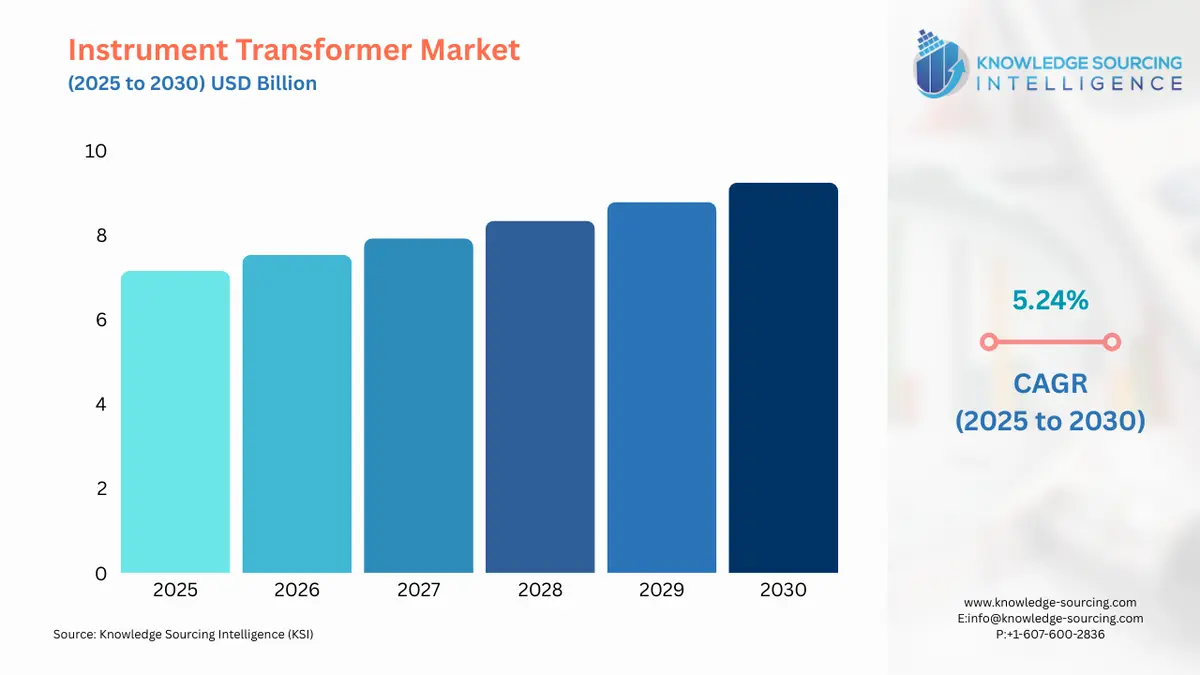
Another element driving development is the expanding renovation work being done on the current grid network as a result of the growing complexity of the electrical infrastructure and the rise in power demand from end users. As per IEA data, the industrial sector used 36.6 EJ of electricity in 2021 and is projected to use 48.9 EJ by 2030. This shows that there will be a high demand for instrument transformers in the future.
Instrument Transformer Market Growth Drivers:
Growing Demand For Sustainable Power Transmission Solutions
Instrument transformers are gaining popularity due to the increased use of renewable energy sources, such as solar panels in residential structures, to make it easier to connect and measure the energy produced by these sources. Instrument transformers make it possible to precisely measure the voltage and current going into and out of household solar energy systems, enabling homeowners to keep track of their energy output and make the most of renewable resources.
According to the World Economic Forum data, Gujarat's residential rooftop solar capacity will expand from 0.085 GW in 2019 to 1.2 GW in 2022, fueling the demand for instrument transformers.
Further, the Centre for Sustainable Systems stated that in 2021, the residential sector consumed 3.79 trillion kWh, or 96% of all the power sold in the United States. The International Energy Agency (IEA) predicts that by 2027, the total electricity generated by renewable sources will increase to 38.10 % of the total energy consumed from 28% in 2021 surging the demand for instrument transformers.
Furthermore, the Power Grid Corporation of India Limited stated in November 2022 that it plans to build a transmission line for roughly USD 2.43 billion to make it easier to move excess power from Raigarh, Chhattisgarh to the south. In May 2022, Hitachi Energy and Arteche announced the formation of a new joint venture (JV) called Arteche Hitachi Energy Instrument Transformers S.L. in compliance with the contract agreed in December 2021.
Instrument Transformer Market Geographical Outlook:
The United States in North America is an Expected Dominant Market
There are several factors that are driving the growth of the instrument transformer market in the USA such as the integration of renewable energy followed by smart grid implementation. The increasing focus on renewable energy sources such as wind and solar power requires advanced monitoring and control systems. Instrument transformers play a vital role in accurately measuring and managing the variable power outputs from these sources, ensuring grid stability.
As per the Center for Climate and Energy Solution, the United States consumption of renewables is anticipated to increase in the next 30 years with an average annual rate of 2.4%, which is higher than the usual growth rate of 0.5% each year. In the United States, renewables made up nearly 20% of utility-scale U.S. electricity generation in 2020 with the bulk power coming from wind power and hydropower which can be seen in the figure below.
Additionally, the transition to smart grids involves the integration of digital technologies for efficient monitoring, communication, and control of the electrical grid. Instrument transformers are crucial for providing real-time data that enables better decision-making and grid optimization.
The USA's power infrastructure has been ageing, leading to the need for upgrades and replacements. Modern instrument transformers with advanced features and technologies can improve the efficiency and reliability of the grid. Moreover, as the population grows and industrial activities expand, the demand for electricity continues to rise. This drives the need for robust and reliable power transmission and distribution infrastructure, in turn boosting the demand for instrument transformers.
Market Segmentation:
By Type
Current Transformer
Potential Transformer
By Voltage
Low
Medium
High
By End-User
Residential
Commercial
Industrial
By Geography
North America
USA
Canada
Mexico
South America
Brazil
Argentina
Others
Europe
Germany
France
United Kingdom
Spain
Others
Middle East and Africa
Saudi Arabia
UAE
Others
Asia Pacific
China
India
Japan
South Korea
Indonesia
Thailand
Others