Report Overview
Healthcare Logistics Market - Highlights
Healthcare Logistics Market Size:
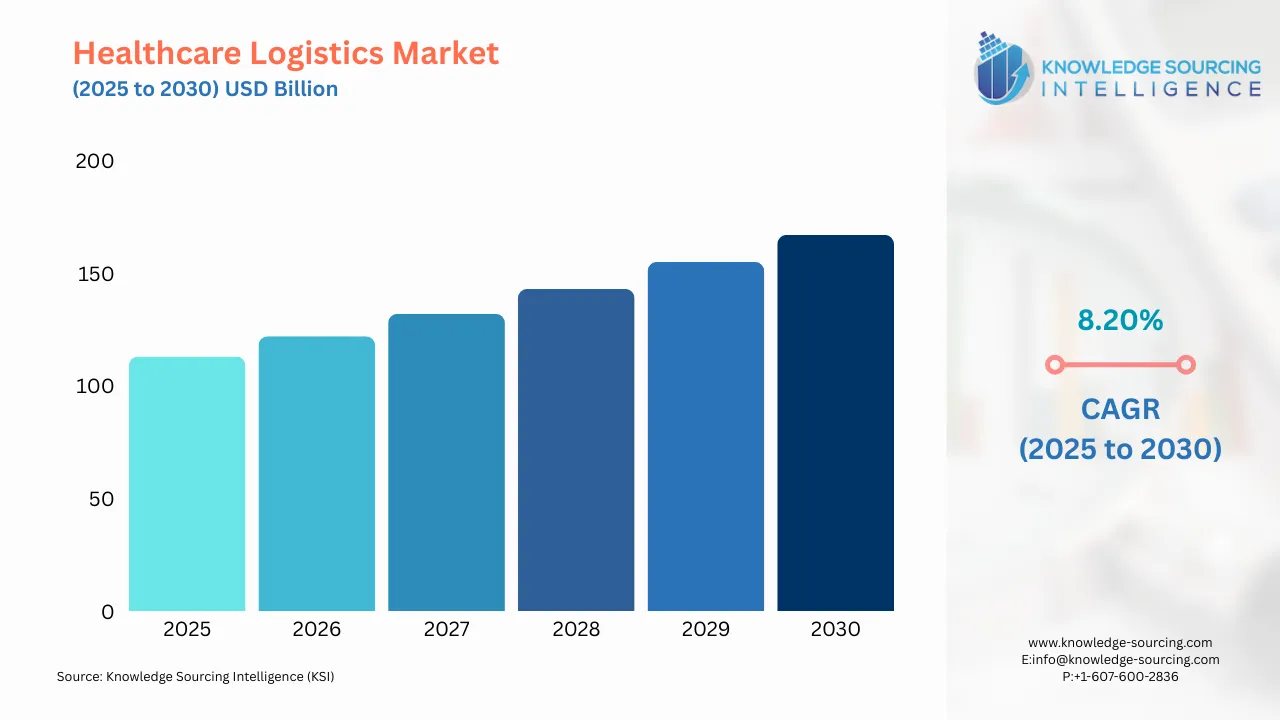
The Healthcare Logistics Market is expected to grow at a 8.20% CAGR, reaching a size of US$167.394 billion in 2030 from US$112.898 billion in 2025.
The Healthcare Logistics market refers to the comprehensive management, distribution, and warehousing of healthcare products, medical devices & equipment, vaccines, and other health-related goods. It plays a crucial role in ensuring an efficient and effective supply chain by enabling the timely and safe delivery of essential products to healthcare providers, pharmacies, hospitals, clinics, and intermediaries to maintain the supply chain. The efficiency and effectiveness of optimizing transportation, warehousing, inventory management, and regulatory compliance in the healthcare logistics market support robust healthcare management in meeting the demands of patients. Concepts like Integrated delivery systems and group purchasing organizations have helped in the evolution of healthcare logistics.
Healthcare Logistics is crucial because it is responsible for transforming the lives of billions of people worldwide. Many industry reports validate the growing healthcare industry, leading the healthcare logistics market growth, as healthcare needs effective and resilient supply chain management. Thus, the growing healthcare industry is one of the key drivers for the healthcare logistics market. Other factors crucial in driving and developing this market include advancements in technology like IoT for real-time tracking, AI for route optimization, blockchain for securing data sharing, etc., by making the healthcare logistics market more efficient and reliable.
Further, in the recent decade, the demand for home healthcare solutions has been a significant factor driving the healthcare logistics market expansion, especially as more individuals require healthcare products and services directly to their homes. Moreover, the growth in e-commerce and B2C healthcare shipments due to online pharmacies and telemedicine has created new opportunities for this market.
Healthcare Logistics Market Growth Drivers:
- The growing focus on building resilience within the expanding healthcare industry is driving the rapid growth of healthcare logistics
The healthcare industry is growing significantly due to the aging population, the rise of chronic diseases, and increased government spending. As per the data from the National Health Institute, in 2021, there were 2.2 million new cases of lung cancer. At the same time, the healthcare industry is focusing on building supply chain resilience to ensure accessibility of medicines, medical devices, medical equipment, vaccines, etc., driving the healthcare logistics market. The priority of reliance on supply chain management is demanding the use of more advanced technologies like AI integration and cold-chain logistics, thus driving innovation in this market.
- The advancement in the logistics technology is driving the market growth
Significant technological developments and innovations in logistics and supply chain management have led to faster and more cost-effective deliveries. The use of artificial intelligence is transforming various industries, including logistics, by enriching the data, enhancing analytics and forecasts, etc., through natural language processing and machine learning. For example, DB Schenker, a key market player, has used AI-powered simulations to find the best optimal linehaul plan, launching Territory Allocation that analyzes data.
Thus, the growing technological advancements and innovations are leading the healthcare logistics market to grow, delivering cost-effective delivery and managing medical products.
Healthcare Logistics Market Segment Analysis:
- The temperature-controlled logistics segment based on service type is anticipated to grow fastest
Healthcare logistics is segmented into three key categories based on service type: Temperature-Controlled Logistics, General Healthcare Logistics, and storage services. During the forecast period, the temperature-controlled logistics segment will be growing fastest.
Temperature-controlled logistics, also known as cold chain logistics, refers to the management and transportation of medical products, such as vaccines, some medicines, blood products, etc., that must be kept in a specific temperature range throughout the supply chain process. The market is anticipated to grow significantly due to the demand for temperature-sensitive medicines and products like vaccines, insulin, etc. The increasing government regulations for ensuring quality and safety are driving the market growth.
Healthcare Logistics Market Geographical Outlook:
- North America will hold the largest market share during the forecast period
Based on Geography, the North American market is estimated to hold a significant market share in the healthcare logistics market. North America is a more mature market for healthcare logistics as it has a more conducive environment, advanced and widespread healthcare infrastructure, and a growing healthcare industry. The region is driven by technological developments, including logistics, propelling market growth in healthcare logistics. Further, the presence of several key market players, like UPS Healthcare, FedEx Healthcare, etc., is significantly driving the region’s growth through offering innovative solutions, efficient supply chains, and specialized services.
On the other hand, the Asia Pacific region will witness significant market expansion during the forecast period due to the rising growth in the healthcare sector and the focus on its logistics.
Healthcare Logistics Market Recent Developments:
- In September 2024, UPS acquired Frigo-Trans and its sister company BPL, which offers healthcare logistics support based in Germany. The acquisition will help UPS deepen its portfolio of solutions by enhancing its end-to-end capabilities with the Frigo-Trans network of temperature-controlled warehousing, a Pan-European cold chain transportation solution, and temperature-controlled and time-critical freight forwarding capabilities.
- In June 2024, DHL Group, a key player in the healthcare logistics market, announced a long-term partnership with Sanofi, a leading healthcare company. DHL Supply will provide warehousing, inventory management, picking, and packaging for three key sites in Sanofi across France. This partnership will strengthen the company's position in the healthcare logistics sector by leveraging its global reach.
- In March 2024, XPO Logistics, a leading European provider of innovative supply chain solutions, expanded its healthcare logistics capabilities by introducing a palletized distribution network. The new network operates across France and is equipped with advanced technologies for real-time tracking and enhanced training for compliance with Good Distribution Practices (GDP).
List of Top Healthcare Logistics Companies:
- CEVA Logistics AG
- FedEx Corp
- DHL Group
- Cold Chain Technologies LLC
- United Parcel Service Inc
Healthcare Logistics Market Scope:
| Report Metric | Details |
|---|---|
| Study Period | 2021 to 2031 |
| Historical Data | 2021 to 2024 |
| Base Year | 2025 |
| Forecast Period | 2026 – 2031 |
| Report Metric | Details |
| Healthcare Logistics Market Size in 2025 | US$112.898 billion |
| Healthcare Logistics Market Size in 2030 | US$167.394 billion |
| Growth Rate | CAGR of 8.20% |
| Study Period | 2020 to 2030 |
| Historical Data | 2020 to 2023 |
| Base Year | 2024 |
| Forecast Period | 2025 – 2030 |
| Forecast Unit (Value) | USD Billion |
| Segmentation |
|
| Geographical Segmentation | North America, South America, Europe, Middle East and Africa, Asia Pacific |
| List of Major Companies in the Healthcare Logistics Market |
|
| Customization Scope | Free report customization with purchase |
The Healthcare Logistics Market is analyzed into the following segments:
- By Product Type
- Pharmaceuticals
- Medical Devices & Equipment
- Vaccines
- Personal Healthcare Products
- By Service Type
- Temperature-Controlled Logistics
- General Healthcare Logistics
- Storage Services
- By Delivery Speed
- Express Delivery
- Regular Delivery
- By End-User
- Hospitals & Clinics
- Diagnostic and Laboratory Centers
- Pharmacies
- Others
- By Geography
- North America
- USA
- Canada
- Mexico
- South America
- Brazil
- Argentina
- Others
- Europe
- United Kingdom
- Germany
- France
- Spain
- Others
- Middle East and Africa
- Saudi Arabia
- UAE
- Others
- Asia Pacific
- China
- Japan
- South Korea
- Australia
- India
- Indonesia
- Thailand
- Others
- North America
Our Best-Performing Industry Reports:
- Blood Pressure Monitoring Devices Market
- Smart Medical Device Market
- Refurbished Medical Equipment Market
Navigation
- Healthcare Logistics Market Size:
- Healthcare Logistics Market Key Highlights:
- Healthcare Logistics Market Growth Drivers:
- Healthcare Logistics Market Segment Analysis:
- Healthcare Logistics Market Geographical Outlook:
- Healthcare Logistics Market Recent Developments:
- List of Top Healthcare Logistics Companies:
- Healthcare Logistics Market Scope:
- Our Best-Performing Industry Reports:
Page last updated on: September 16, 2025