Report Overview
Control Cable Market Size, Highlights
Control Cable Market Size:
The control cable market will grow at a CAGR of 3.41% to reach US$25.01 billion in 2030 from US$21.15 billion in 2025.
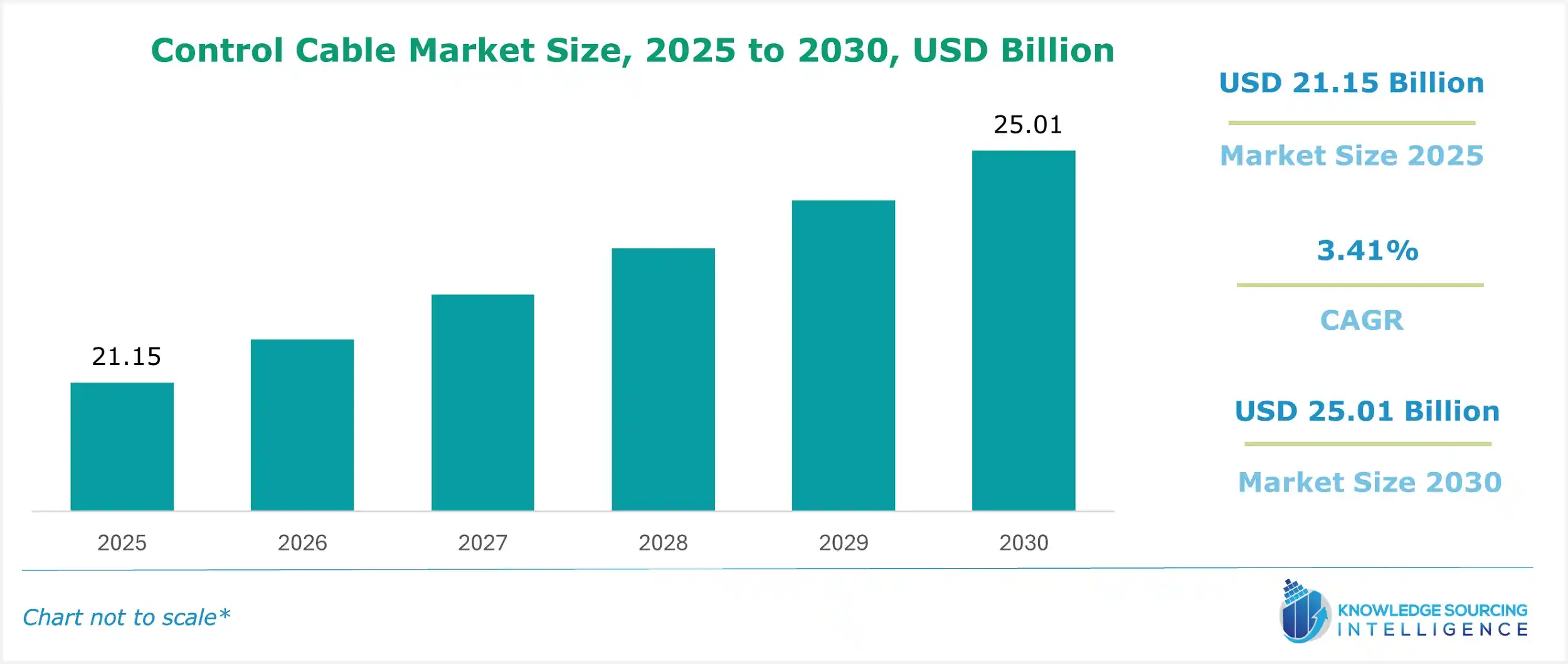
Control Cable Market Trends:
The instrumentation cables which send signals that have low voltage in order to regulate the functioning of a device are called control cables. These cables are intended specifically for automation controls as they have a copper conductor and are used for areas that require low voltage. Control cables have better interference resistance than power cables, which makes them appropriate for transmitting low-voltage signals. These are also used for wiring control circuits and work at low power. The control cables exhibit high flexibility, having multi-core cables along with copper conductors. The growing automotive industry and rising infrastructure spending will drive the demand for control cables worldwide. Moreover, companies are investing to explore new applications of control cables, which will further augment the demand for control cables during the forecast period.
The market for control cables is majorly driven by rapidly expanding end-user sectors, such as automotive, rail & transportation, and building & construction, owing to fast-paced industrialization and urbanization. In 2024, the automotive sector accounted for a major share of the global control cables market, driven by the increasing adoption of electric vehicles (EVs) and advanced automation systems. Moreover, increasing applications of control cables in renewable energy projects, such as wind and solar farms, are further contributing to the market growth significantly. Government spending on infrastructure development, especially in developing countries, and continuous product innovation are expected to create ample opportunities for the vendors of these cables over the projected period. For instance, in 2023, the Indian government announced an investment of USD 1.4 trillion in infrastructure development under its National Infrastructure Pipeline (NIP), which is expected to boost the demand for control cables in the region.
Control Cable Market Geographical Outlook:
Geographically, Asia Pacific is expected to drive the demand for control cables on account of demand originating from expanding end-use sectors and the presence of several control cable manufacturers. In 2024, Asia Pacific held the largest share globally with China, India, and Japan being the major markets. The region's growth is fuelled by rapid urbanization, industrialization, and government initiatives to develop smart cities and transportation networks. For instance, China's Belt and Road Initiative (BRI) and India's Smart Cities Mission are driving significant demand for control cables in infrastructure and automation projects. Moreover, ongoing technological improvements in the region, such as the adoption of Industry 4.0 and IoT-enabled automation systems, are expected to have a significant impact on market growth. Europe and North America are also expected to witness steady growth, driven by the modernization of aging infrastructure and the increasing adoption of renewable energy projects.
The global control cable market report provides a detailed analysis of the industry landscape, offering strategic and executive-level insights supported by data-driven forecasts and analysis. This regularly updated report equips decision-makers with actionable intelligence on current market trends, emerging opportunities, and competitive dynamics. It explores consumer demand across various regions and product types, such as power control cables, instrumentation cables, and communication cables, while also examining purchasing behaviours and key customer segments. Additionally, the report delves into technological advancements, key government policies, regulations, and macroeconomic factors, delivering a comprehensive overview of the global control cable market.
Control Cable Market Segmentations:
Global Control Cable Market Segmentation by type:
The market analyzed by type into the following:
- Screened Control Cable
- Unscreened Control Cable
Global Control Cable Market Segmentation by material:
The market analyzed by material into the following:
- Polyurethane
- Polyvinyl Chloride (PVC)
- Cross Linked Polyethylene (XLPE)
- Others
Global Control Cable Market Segmentation by voltage type:
The market analyzed by voltage type into the following:
- High Voltage
- Medium Voltage
- Low Voltage
Global Control Cable Market Segmentation by end-user:
The market analyzed by end-user into the following:
- Powers & Utilities
- Construction
- Automotive
- Industrial
- Others
Global Control Cable Market Segmentation by regions:
The study also analysed the global control cable market into the following regions, with country level forecasts and analysis as below:
Global Control Cable Market Competitive Landscape:
The global control cable market features key players such as Belden Inc, Texcan, Prysmian S.p.A., Nexans S.A, Multi Cable Corporation, ZW Cable, KEC International, KEI Industries, Havells India Limited, Polycab India Limited, Elliot Manufacturing (CentroMotion) among others.
Global Control Cable Market Report Coverage:
This report provides extensive coverage as explained in the points below:
- Control Cable Market size, forecasts, and trends by species, with historical revenue data and analysis focusing on key factors driving adoption, current challenges faced by key players, and major growth areas.
- Control Cable Market size, forecasts, and trends by environment, with historical revenue data and analysis.
- Control Cable Market size, forecasts, and trends by farming type, with historical revenue data and analysis.
- The global control cable market is also analysed across different regions, with historical data, regional share, attractiveness and opportunity of these solutions in different countries. The growth prospects and key players operating in these markets. The section also dwells on the macro factors, economic scenario and other complementing factors aiding in market growth.
- Market dynamics: The section details the market growth factors, restraints, and opportunities in the market. The segment also presents complete market scenario with the help of Porter’s five forces model.
- Competitive Intelligence: A thorough investigation on the competitive structure of the market presented through proprietary vendor matrix model, market share analysis of key players, insights on strategies of key players and recent major developments undertaken by the companies to gain competitive edge.
- Research methodology: The assumptions and sources which were considered to arrive at the final market estimates. Additionally, how our model is refined to ensure most significant factors are taken into consideration with the proper hypothesis and bottom-up and top-down approaches enhance the reliability of forecasts further strengthening the trustworthiness of the numbers being presented.
How this report is helpful to you and reasons for purchase?
- The report provides a strategic outlook of the control cable market to the decision-makers, analysts and other stakeholders in the easy to read format for taking informed decisions.
- The charts, tables and figures make it easy for the executives to gain valuable insights while skimming the report.
- Analyst support through calls and email for timely clarification and incorporating additional requests.
- Option of presentation or doc format with the estimates file to take care of diverse requirements.
- 15% FREE customization with all our reports help cater additional requirements with significant cost-savings.
- Option of purchasing specific segments of the study, including opting for summary reports or just the estimates file.
Control Cable Market Scope:
| Report Metric | Details |
|---|---|
| Study Period | 2021 to 2031 |
| Historical Data | 2021 to 2024 |
| Base Year | 2025 |
| Forecast Period | 2026 – 2031 |
| Report Metric | Details |
| Control Cable Market Size in 2025 | US$21.15 billion |
| Control Cable Market Size in 2030 | US$25.01 billion |
| Growth Rate | CAGR of 3.41% |
| Study Period | 2020 to 2030 |
| Historical Data | 2020 to 2023 |
| Base Year | 2024 |
| Forecast Period | 2025 – 2030 |
| Forecast Unit (Value) | USD Billion |
| Segmentation |
|
| Geographical Segmentation | North America, South America, Europe, Middle East and Africa, Asia Pacific |
| List of Major Companies in the Control Cable Market |
|
| Customization Scope | Free report customization with purchase |