Report Overview
Cognitive Diagnostics Market - Highlights
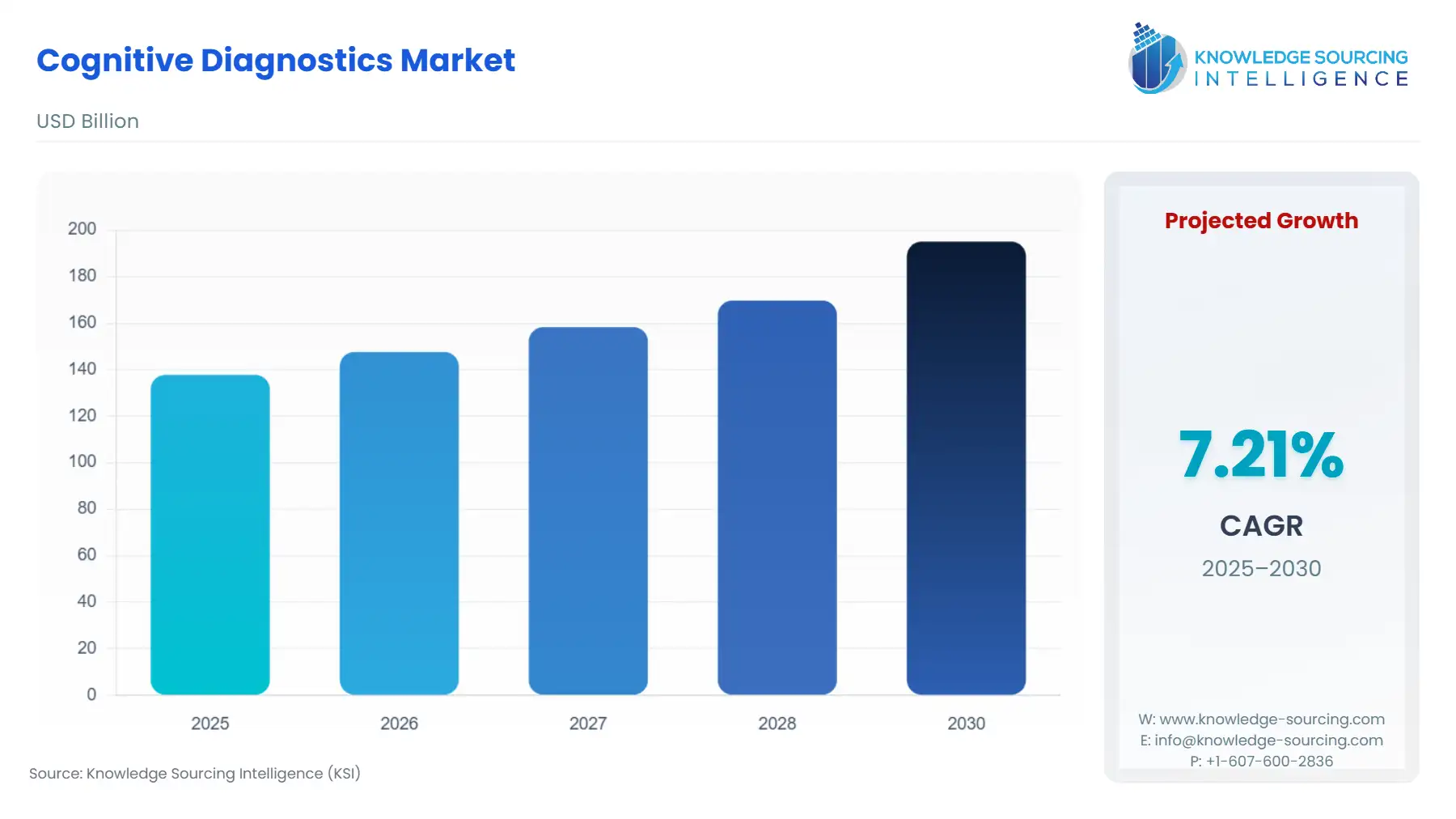
The cognitive diagnostics market is projected to grow at a CAGR of 7.21% over the forecast period, increasing from US$137.738 billion in 2025 to US$195.061 billion by 2030.
The cognitive diagnostics market is related to the field of medical technology that involves the assessment and diagnosis of cognitive disorders. The cognitive diagnostics market is driven by factors such as the increasing geriatric population, growing chronic disease ailments, and rising awareness about cognitive decline. As per the research, certain cognitive functions, including memory, executive functions, processing speed, and reasoning, begin to decline as early as the thirties. Furthermore, studies suggest that mild cognitive impairment affects 10-20% of adults over 65, with the potential to evolve into more severe cognitive issues.
The introduction of innovative products and new metrics related to cognitive functions is further bolstering the market. Muse by Interaxon announced the launch of a new cognitive performance metric, Alpha Peak in September 2024. As the first in a suite of advanced brain health metrics, Alpha Peak empowers users to enhance cognitive performance through personalized, actionable insights with an easy-to-understand score paving the way for enhanced mental fitness. The users can monitor lifestyle factors such as diet, exercise, and sleep, which can directly correlate changes with their Alpha Peak score, and receive personalized prompts to optimize their habits accordingly.
The major development had been taking place through strategic partnerships and investments. In August 2024, Firefly Neuroscience, Inc. announced that it formed a strategic partnership with the Neurology Consultants of Dallas. (NCD) This would help to enhance early detection efforts and disease management for patients suffering from cognitive decline. NCD would incorporate Firefly’s Brain Network Analytics technology into its patient workflow and conduct clinical studies. Firefly Neuroscience, Inc. is an artificial intelligence technology company developing innovative neuroscientific solutions to improve brain health outcomes for patients with mental illnesses and neurological disorders.
Further, C?N Diagnostics, LLC, and Eisai Inc., announced that Eisai invested up to 15 million USD in C?N in March 2024. The investment reflects that companies shared a desire to scale up and provide broad access to their Precivity tests. Precivity tests are innovative blood tests intended for use in patients with cognitive impairment. These tests aim to help healthcare providers to determine Alzheimer’s disease pathology and aid in medical management and treatment decisions.
Cognitive Diagnostics Market Drivers:
Rising population geriatric population
The growing elderly population worldwide is the leading cause of the demand for cognitive diagnostics and treatments. The aging population has an immense effect on the healthcare sector. According to the WHO[1], by 2030, 1 in 6 people will be 60 years or over. By then, the share of the population aged 60 years will be 1.4 billion.
By 2050, the world’s population of people aged 60 years and older will be 2.1 billion. The cognitive diagnostics market will benefit from this increasing elderly population. A disease like Alzheimer's is the most common form of dementia among older adults. This is an irreversible degeneration of the brain that causes disruptions in memory, cognition, personality, and other functions. Further, Parkinson's disease is the second most neurodegenerative disease, after Alzheimer's disease, which affects up to two million Americans, mostly aged 60 and older. These diseases need proper diagnostics and treatments, hence the cognitive diagnostics market will be fueled by the growing grey population.
Growing chronic disease ailments among a large population
Chronic diseases tend to be of long duration and are the result of a combination of genetic, physiological, environmental, and behavioral factors. The major types of chronic diseases are heart attacks, stroke, cancer, diabetes, asthma, etc. Most of these diseases account for 80% of all premature deaths. The increasing number of chronic diseases and ailments can cause long-term and short-term cognitive impairment. The proper cognitive diagnostics are needed to understand the complications of these cognitive impairments.
Cognitive Diagnostics Market Geographical Outlook:
By geography, the cognitive diagnostics market is segmented into North America, South America, Europe, Middle East and Africa, and Asia Pacific. The major economies like China, Japan, India, and South Korea dominate the Asia-Pacific region. Some of the fastest-growing emerging economies are from this region such as ASEAN countries.
The Asia Pacific region is expected to see notable growth in the growing healthcare industry, increasing the population of the elderly, and growing concern for chronic ailments. According to the Asian Development Bank, by 2050, one in four people in Asia and the Pacific will be over 60 years old. The population aged over 60 in the region will triple between 2010 and 2050, reaching close to 1.3 billion people. In some countries, this transition will happen very rapidly, such as China, Japan, South Korea, and Vietnam. Further, growing research on the fields of depression, insomnia, and PTSD, will increase the demand for devices, devices, and drugs towards enhancing the quality of life for those affected in the region.
Cognitive Diagnostics Market Key Developments
The market leaders for the cognitive diagnostics market are Cognivue, Inc., Cambridge Cognition Ltd., Diadem srl, CN Diagnostics, Cogstate Ltd., Viz.ai, Mind Maze, Neurocare Group AG, Anderson Diagnostics & Labs., Altoida AG, BrainScope Company Inc., Neurotrack Technologies Inc., BrainCheck, and Cyclops MedTech Pvt Ltd.. The key players in the market implement growth strategies such as product launches, mergers, acquisitions, etc. to gain a competitive advantage over their competitors. For Instance,
In October 2024, Altoida announced the launch of its Scientific Advisory Board (SAB). Altoida is a company in digital neuromarker diagnostics for neurological conditions. The newly appointed experts would give advice and play a pivotal role in advancing Altoida’s artificial intelligence (AI) and augmented reality (AR)-based Digital NeuroMarker Platform. The SAB would guide the Company in driving innovations in the early detection and intervention of cognitive and functional impairments tied to neurodegenerative disorders like Alzheimer’s disease.
In October 2024, Cognetivity Neurosciences Ltd. announced a collaboration with the Mediclinic Group. Mediclinic Group is a prominent international private hospital group operating across Europe, the Middle East, and Southern Africa. This partnership would start in the United Arab Emirates. Under the agreement, Cognetivity's cognitive assessment platform, CognICA, would be integrated into Mediclinic's healthcare services. CognICA would harness the power of artificial intelligence (AI) and machine learning to deliver rapid, accurate, and non-invasive cognitive assessments. This would change the brain health diagnosis and care in the region. This addresses the escalating concern around Alzheimer's disease and other cognitive health issues.
In August 2024, Unilabs and C2N Diagnostics LLC, a pioneer in advanced diagnostic solutions in the field of Alzheimer’s disease (AD) and related neurological disorders, announced a major advancement in brain health diagnostics. They signed a multi-year partnership agreement that would increase access to C2N’s Precivity portfolio of blood tests on an exclusive basis in Europe, including Norway, Switzerland, and the United Kingdom. The agreement would also provide access to Peru, Saudi Arabia, and the United Arab Emirates. This strategic partnership also facilitates a technology transfer of C2N’s proprietary portfolio of Alzheimer’s blood biomarkers to deliver a Unilabs testing network across Europe.
Cognitive Diagnostics Market Scope:
| Report Metric | Details |
|---|---|
| Total Market Size in 2025 | USD 137.738 billion |
| Total Market Size in 2030 | USD 195.061 billion |
| Forecast Unit | Billion |
| Growth Rate | 7.21% |
| Study Period | 2020 to 2030 |
| Historical Data | 2020 to 2023 |
| Base Year | 2024 |
| Forecast Period | 2025 – 2030 |
| Segmentation | Diagnosis, Indication, End User, Geography |
| Geographical Segmentation | North America, South America, Europe, Middle East and Africa, Asia Pacific |
| Companies |
|
Cognitive diagnostics market Segmentation
By Diagnosis
Brain Imaging Tests
Laboratory Testing
Mental Status Testing
Rapid Home Screening Tests
Neuropsychological Testing
Electroencephalogram (EEG)
Cognitive Function And Behavioral Tests
Neuropsychiatric Inventory Questionnaire
By Indication
Alzheimer’s Disease
Attention Deficit / Hyperactivity Disorder
Dementia
Epilepsy-Related Cognitive Dysfunction
Mild Cognitive Impairment
Parkinson’s Disease-Related Cognitive Dysfunction
Stroke-Related Cognitive Dysfunction
Traumatic Brain Injury
Others
By End User
Hospitals
Neurology Clinics
Cognitive Behavioral Therapy Centers
Rehabilitation Centers
Academic And Research Institutes
Diagnostic Imaging Centers
Others
By Geography
North America
USA
Canada
Mexico
South America
Brazil
Argentina
Others
Europe
United Kingdom
Germany
France
Italy
Spain
Others
Middle East and Africa
Saudi Arabia
UAE
Israel
Others
Asia Pacific
China
India
Japan
South Korea
Taiwan
Thailand
Indonesia
Others