Report Overview
Artificial Intelligence (AI) In Highlights
AI In Wound Care Market Size:
Artificial Intelligence (AI) in the wound care market is projected to grow at a CAGR of 18.33% over the forecast period, increasing from US$3.32 billion in 2025 to US$7.65 billion by 2030.
Artificial intelligence in wound care brings solutions powered by AI that allow computers and machines to work with the alphanumeric prescription of mimetic problem-solving capabilities alongside human intelligence for expedited wound diagnosis, assessment, monitoring, and treatment. Furthermore, the burgeoning costs associated with the last decade's wound care management have become a great burden even in the Medicare (the US government's health insurance program) sector. This has also significantly reflected on the whole healthcare sector (cutting down fund allocations to healthcare providers and services), causing a financial burden that greatly reduces access to care, increases waiting times, and possibly lowers quality.
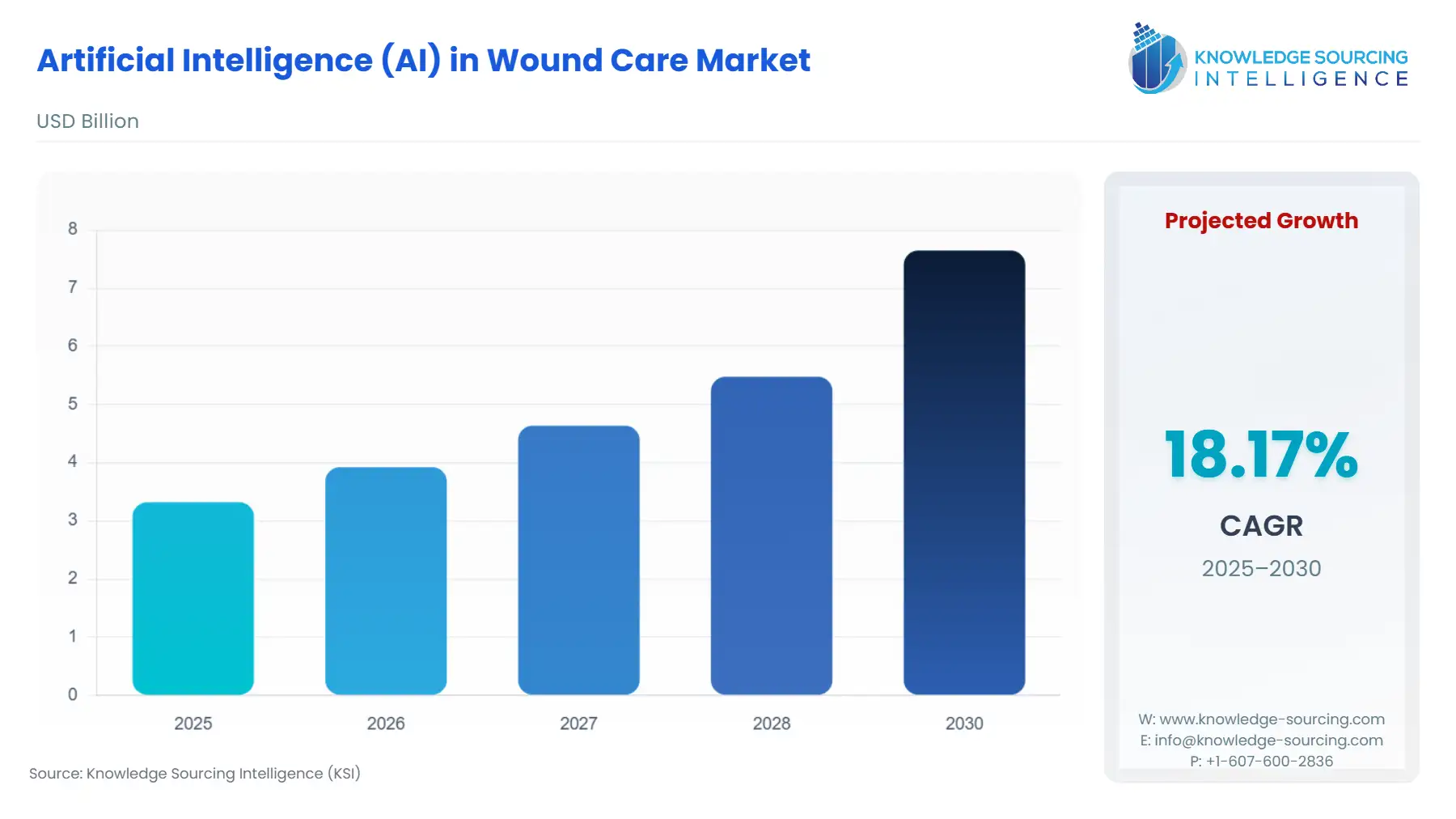
Moreover, AI in wound care will continuously find ways to overcome the current barriers posed by traditional treatment processes. Among other AI technologies, machines and deep learning have emerged as productive routes to artificial intelligence in wound care. In addition, the experts are confident that synergizing wound care with AI technology has immense income comprehensiveness potential, thanks to the emerging effective chronic diseases and the ability of AI to enhance competency in digital wound care for developing new technologies. Such discoveries and advancements and increased investment activity in this field are expected to propel AI in the wound care market growth.
AI In Wound Care Market Growth Drivers:
-
The rising prevalence of diabetes bolsters Artificial Intelligence in wound care market growth
The growth trajectory of AI in the wound care market is likely to be propelled by the increase in diabetes cases ever reported. Diabetes is one chronic condition that demonstrates increased blood sugar levels and can eventually result in complications such as heart disease, kidney failure, neuropathy, and even loss of eyesight. It mostly affects older populations as the risk of having diabetes increases with age, and the increasing prevalence of diabetes is associated with high rates of obesity, which are responsible for increased odds of getting type 2 diabetes. AI in wound care improves diabetes control through accurate assessments of wounds and delivery of individualized treatment regimens, enhancing the efficiency and effectiveness of diabetic ulcer treatments.
For instance, in May 2024, a US-based government agency, the Centers for Disease Control and Prevention, reported that there were 38.4 million people with diabetes in the US, or 11.6% of the population. The prevalence increased significantly to 29.2% among those aged 65 and older. Thus, there is an increase in the incidence of wounds brought about by diabetes, boosting AI in the wound care market expansion.
-
Innovative AI-powered solutions are revolutionizing wound care management
The leading AI companies in the wound care market tend to focus on advancements such as incorporating digital wound care management developments. This would improve assessment and treatment outcomes in wounds. Programs on digital wound care management are software solutions that employ technology to evaluate, monitor, and manage wound healing. The program also gives individualized treatment suggestions and remote patient monitoring services.
For instance, a UK-based leader in the specialization of wound care, NATROX Wound Care, runs NATROX IQ, an advanced digital platform powered by AI technology to advance wound management practice for clinical teams. This innovative cloud-enabled program provides a unified tracking platform and facilitates real-time data accessibility, fostering better communication between healthcare providers concerning patient wound care.
-
Rising government initiatives are also increasing the demand
Extensive government campaigns in recent years have been raising awareness for proper AI use in health for wound care systems. The importance of adopting AI technologies is visible in diagnosing accuracy, predicting wound healing outcomes, and formulating individualized treatment strategies, which are big areas of concern for healthcare practitioners.
Globally, governments are interested in AI-based healthcare services to improve delivery, cut costs, and improve patient outcomes. The United States has also developed the National Artificial Intelligence Initiative Act and several programs funded by the Department of Health and Human Services (HHS), which seeks to advance the integration of AI technologies into medical activities, especially wound care. There is a specific emphasis on research, development, and implementation of AI tools in these programs that aid innovations in health care. Analogously, the European Union's AI Strategy emphasizes the empowerment of innovative technologies in revolutionizing healthcare by channeling funds to AI-based diagnosis and therapeutic methodologies.
AI In Wound Care Market Segment Analysis:
-
By type, chronic wound is anticipated to grow during the forecast period
The increase in the development of chronic wounds has made the Al in wound care market flourish. With the continuous development of new wound management techniques, chronic wounds like diabetic foot ulcers, venous leg ulcers, and pressure ulcers might take months or potentially years to heal.
Such chronic wounds can only be managed by intensive and long-term treatment. This highly complex and delayed healing process needs innovativeness in understanding the quality of care and the resultant outcomes. It was witnessed that AI-based equipment includes predictive analytics, image-based wound assessment, and personalized treatment suggestions as tools in wound care. These innovations create extensive outcomes in wound diagnosis and healing processes that can be effectively monitored in real-time, allowing early intervention to reduce potential complications and enhance patient outcomes. This will meet the urgent need for better efficiency and efficacy in wound care in the coming years. Mostly, old wound assessment and treatment methods rely on subjectivity and are extremely time-consuming, leading to highly variable quality in care.
AI In Wound Care Market Geographical Outlook:
-
North America is witnessing exponential growth during the forecast period
North America dominates AI in the wound care market due to the advanced healthcare infrastructure, technological investments, and large industry players. Chronic wounds like diabetic ulcers and pressure sores keep creating a growing demand for new wound care options. Different governments are also running support programs and funding for healthcare innovations, which stimulate the introduction of AI technologies in wound evaluation, management, and therapy. In addition, investment in R&D attempts warrants continued dominance of the region through partnerships between healthcare providers and technology companies. These partnerships motivate the advancement of pioneering tools in AI to upgrade wound care procedures and improve outcomes in patients. The market expansion is created by an increased awareness among healthcare professionals and patients of how Al can make a difference in wound care.
AI In Wound Care Market Key Launches:
- In July 2024, Spectral AI Inc., a US-based AI startup, partnered with PolyNovo to offer the DeepView System in Australia, which is meant to assess the healing capacity of burn wounds.
List of Top AI In Wound Care Companies:
- KroniKare Pte Ltd
- Swift Medical
- Wound Vision
- EKare Inc.
- Healthy. io
Artificial Intelligence (AI) In Wound Care Market Scope:
| Report Metric | Details |
| AI In Wound Care Market Size in 2025 | US$3.32 billion |
| AI In Wound Care Market Size in 2030 | US$7.65 billion |
| Growth Rate | CAGR of 18.33% |
| Study Period | 2020 to 2030 |
| Historical Data | 2020 to 2023 |
| Base Year | 2024 |
| Forecast Period | 2025 – 2030 |
| Forecast Unit (Value) | USD Billion |
| Segmentation |
|
| Geographical Segmentation | North America, South America, Europe, Middle East and Africa, Asia Pacific |
| List of Major Companies in the AI In Wound Care Market |
|
| Customization Scope | Free report customization with purchase |
The Artificial Intelligence (AI) In wound care market is analyzed into the following segments:
- By Type
- Acute Wound
- Chronic Wound
- By Technology
- Deep Learning
- Machine Learning
- Other Technologies
- By End-User
- By Geography
- North America
- USA
- Canada
- Mexico
- South America
- Brazil
- Argentina
- Others
- Europe
- Germany
- UK
- France
- Spain
- Others
- Middle East and Africa
- UAE
- Israel
- Others
- Asia Pacific
- China
- Japan
- South Korea
- India
- Indonesia
- Taiwan
- Thailand
- Others
- North America