Report Overview
Anti-Agers Market - Strategic Highlights
Anti-Agers Market Size:
The Anti-Agers Market is expected to grow at a rate of 6.29% CAGR, reaching a market size of US$68.792 billion in 2030 from US$54.330 billion in 2025.
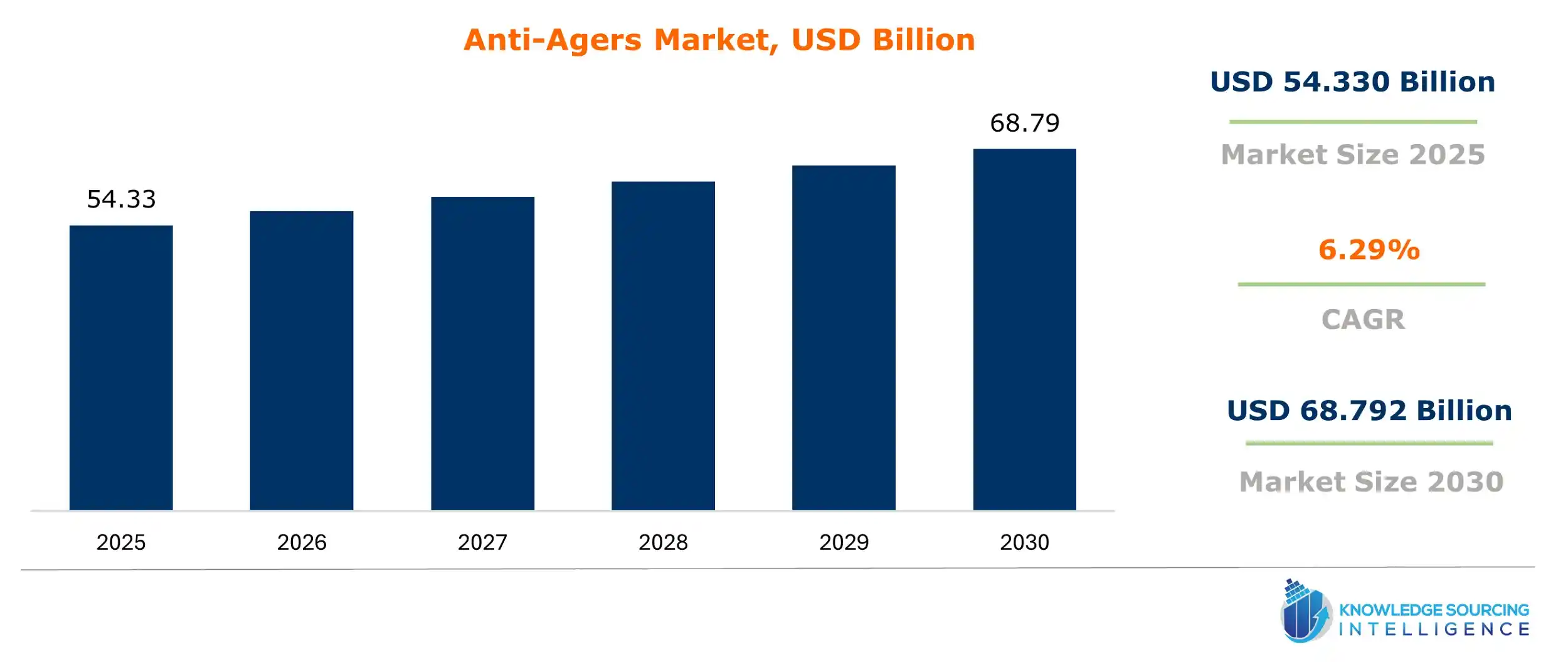
The primary concerns about physical appearance are largely linked to the visible changes that occur as a result of aging. Many products are available in the market, such as anti-stretch mark creams, anti-wrinkle creams, UV absorbers, and others, which help to slow down these physical changes while treating skin-related problems. Increasing disposable incomes and living standards have increased people's attention towards their well-being and looks, driving anti-agers market growth.
The anti-agers market includes that segment of the beauty and personal care industry that focuses on treating skin problems related to aging. It includes those products specifically designed to treat reducing collagen production in the skin, reducing the skin's elasticity, fragile skin, reducing moisture retention, reducing cell turnover, and many others that lead to visible effects of aging. The anti-agers market includes products such as creams, lotions, serums, masks, etc. that are specifically designed for treating these issues.
Anti-Agers Market Growth Drivers:
- The growing geriatric population is driving the market
The growing global aging population is boosting the demand for various anti-aging products. According to the United Nations, the global share of the population aged 65 years and above increased. Between 2015 and 2050, this proportion of the global population will nearly double from 12% to 22%. In 2030, 1 in 6 people in the world will be aged 60 years or over. Intrinsic aging leads to changes in physical skin appearance, such as loss of skin elasticity, melanin production, and fine lines, among others. Since consumers are increasingly opting for anti-aging products to limit the occurrence of these changes, growing beauty consciousness among people, the demand for various anti-ager products is increasing significantly, thus fuelling the overall market growth. The harmful impact of sun rays and environmental pollution on the skin, causing early signs of aging, is also a factor boosting the demand for various anti-agers among women, especially the younger generation worldwide, thus spurring the overall market growth.
- Increasing research and development is leading the market growth
Market players are investing heavily in R&D to offer a wide range of effective yet safe anti-aging products. With the adoption of various growth strategies by global anti-ager vendors, such as product launches, partnerships and collaborations, and acquisitions, the market for anti-agers will grow during the forecast period. The emerging popularity of anti-agers made with natural ingredients is further providing lucrative opportunities for companies to expand their customer base, thereby bolstering the global anti-ager market’s growth in the coming years. The growing trend of personal grooming among men will further drive the anti-aging market growth during the next five years. As such, market players are also diversifying their product portfolios across this segment to maintain their market position while gaining a larger global market share. With this tremendous growth of the anti-aging market, many new companies are entering this industry, thus increasing market competition and boosting market expansion.
Anti-Agers Market Segmentation Analysis:
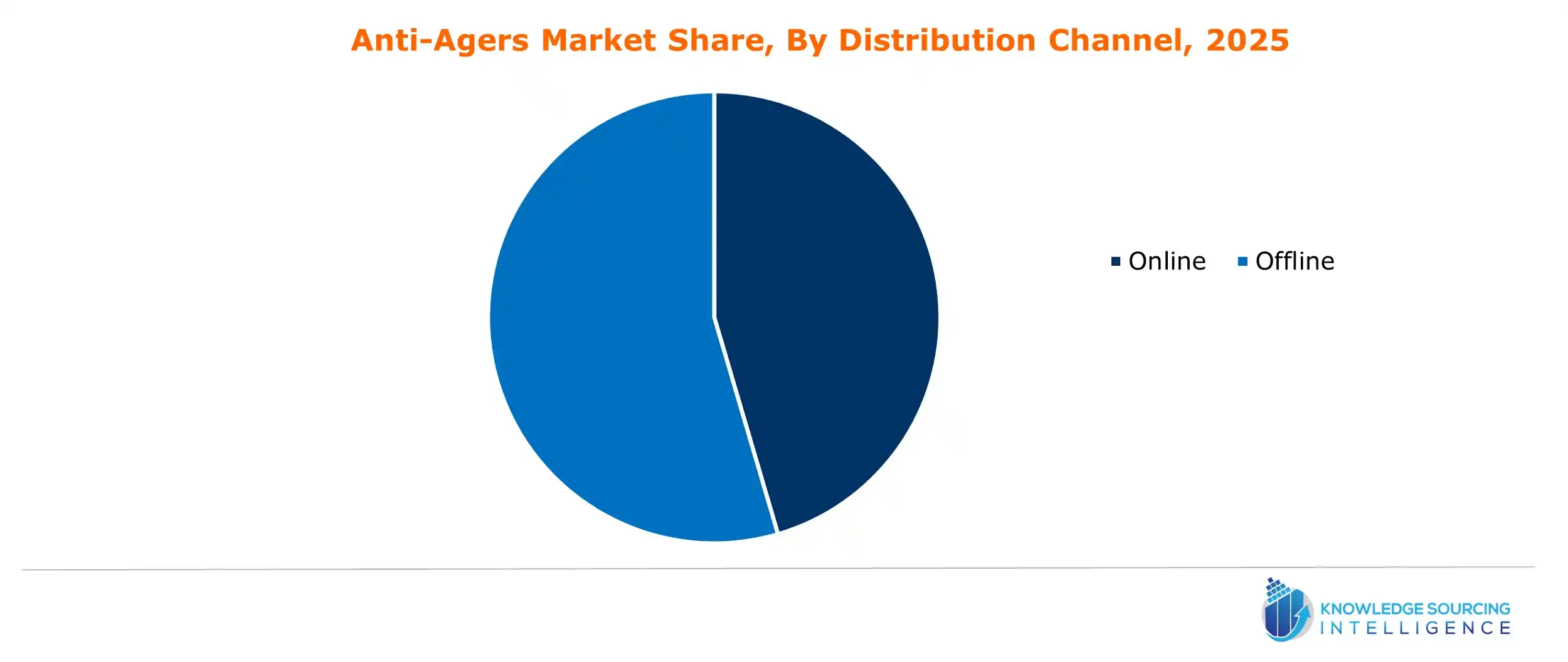
- The online segment, based on the distribution channel, will be witnessing a higher CAGR during the forecast period
The online segment will witness a higher CAGR during the forecast period, majorly due to the growing penetration of smartphones and better internet connectivity. The growing female working population is driving the demand for premium-quality international anti-agers, which they can buy conveniently and at discounted rates online.
Offline stores will hold a decent market share as people get first-hand information about several available products and make better purchasing decisions with the help of sales services provided at physical stores.
Anti-Agers Market Geographical Outlook:
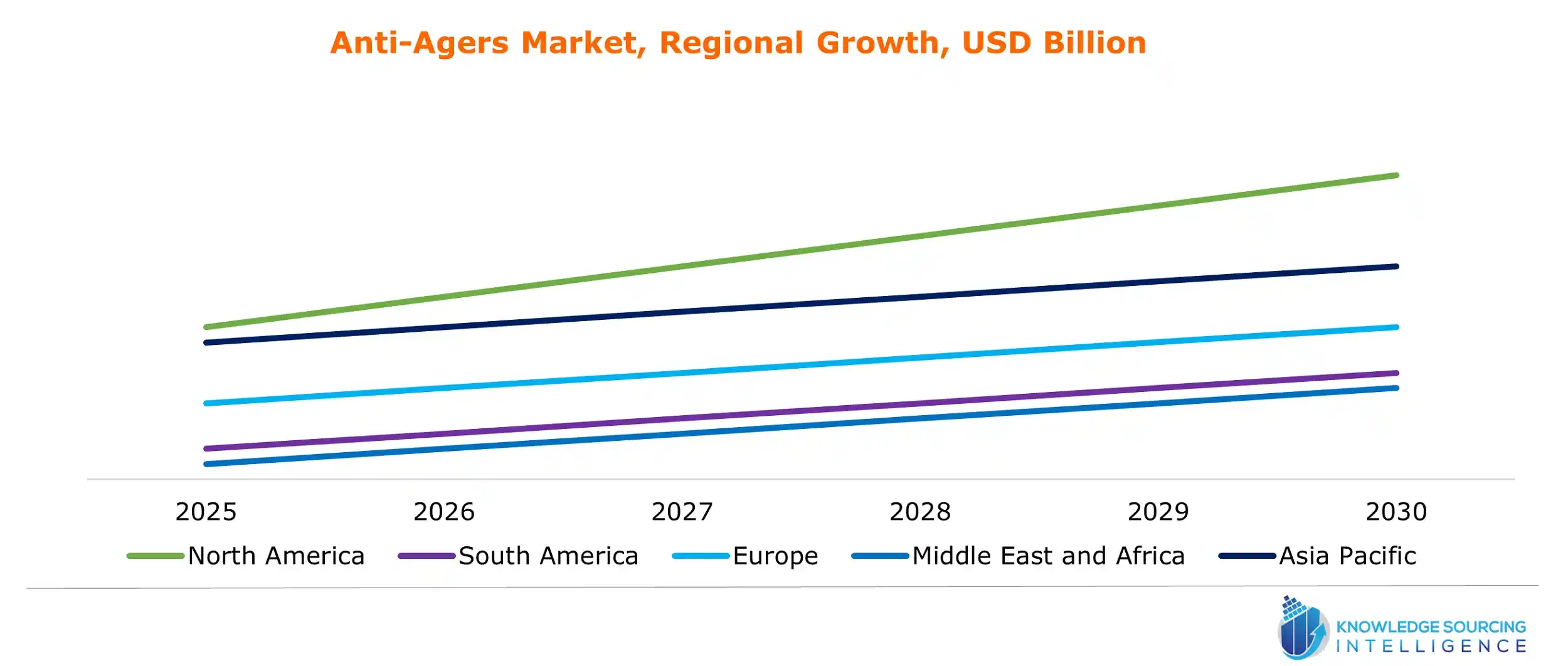
- North America will hold the largest market share during the forecast period
The global Anti-Agers market is geographically segmented into North America, South America, Europe, the Middle East, Africa (MEA), and Asia Pacific (APAC).
North America held a significant share of the global anti-agers market and will do so until the end of the forecast period. The presence of major market players and a high focus on reducing early signs of anti-aging among women are also bolstering the overall regional market growth. The booming aging population in countries like the U.S., where the population aged 65 and over grew nearly five times faster than the total population over the 100 years from 1920 to 2020, according to the 2020 Census as per the United States Census Bureau and Canada will further continue to fuel the demand for anti-agers in this region, thereby driving market growth.
- Europe also holds a noteworthy market share throughout the forecast period owing to its high demand for premium quality anti-aging products
Asia Pacific (APAC) will also witness a significant compound annual growth rate during the forecast period. Rising awareness about various anti-aging skin care products in countries like China, India, and Australia and the presence of major market players in the region are boosting the demand for anti-ager products across APAC countries. The growing middle-class population, rising disposable income, and increasing urbanization are also augmenting the demand for premium anti-aging products in this region, fuelling regional market growth. The booming e-commerce industry is also supporting the rising sales of international anti-aging products, thus positively impacting the market growth of anti-agers in the Asia Pacific.
Anti-Agers Market Key launches:
- In April 2024, Beiersdorf, a global leader in anti-aging products, unraveled its new research and development of the glycation process and patented an active ingredient to combat sugar-induced skin aging and wrinkle formation. This anti-aging product, NIVEA Q10 Dual Action Serum, is available in stores.
- In October 2024, DefenAge Skincare launched its anti-ageing serum. It has a 12-factor revitalizing lip enhancer designed to rejuvenate lip appearance, smooth fine lines, and a plumper look. It is based on DefenAge's patented Age-Repair Defensins®.
List of Top Anti-Agers Companies:
- Beiersdorf
- Procter & Gamble
- THE ESTÉE LAUDER COMPANIES
- L'Oréal
- Elizabeth Arden
Anti-agers Market Scope:
| Report Metric | Details |
|---|---|
| Study Period | 2021 to 2031 |
| Historical Data | 2021 to 2024 |
| Base Year | 2025 |
| Forecast Period | 2026 – 2031 |
| Report Metric | Details |
| Anti-Agers Market Size in 2025 | US$54.330 billion |
| Anti-Agers Market Size in 2030 | US$68.792 billion |
| Growth Rate | CAGR of 6.29% |
| Study Period | 2020 to 2030 |
| Historical Data | 2020 to 2023 |
| Base Year | 2024 |
| Forecast Period | 2025 – 2030 |
| Forecast Unit (Value) | USD Billion |
| Segmentation |
|
| Geographical Segmentation | North America, South America, Europe, Middle East and Africa, Asia Pacific |
| List of Major Companies in Anti-Agers Market |
|
| Customization Scope | Free report customization with purchase |
The Anti-agers Market is analyzed into the following segments:
- By Product Type
- UV Absorber
- Anti-Wrinkle
- Anti-Stretch Mark
- Others
- By End User
- Men
- Women
- By Distribution Channel
- Online
- Offline
- By Geography
- North America
- USA
- Canada
- Mexico
- South America
- Brazil
- Argentina
- Others
- Europe
- United Kingdom
- Germany
- France
- Spain
- Others
- Middle East and Africa
- Saudi Arabia
- UAE
- Israel
- Others
- Asia Pacific
- China
- Japan
- South Korea
- Australia
- India
- Indonesia
- Thailand
- Others
- North America