Report Overview
Artificial Intelligence (AI) In Highlights
AI In Precision Therapies Market Size:
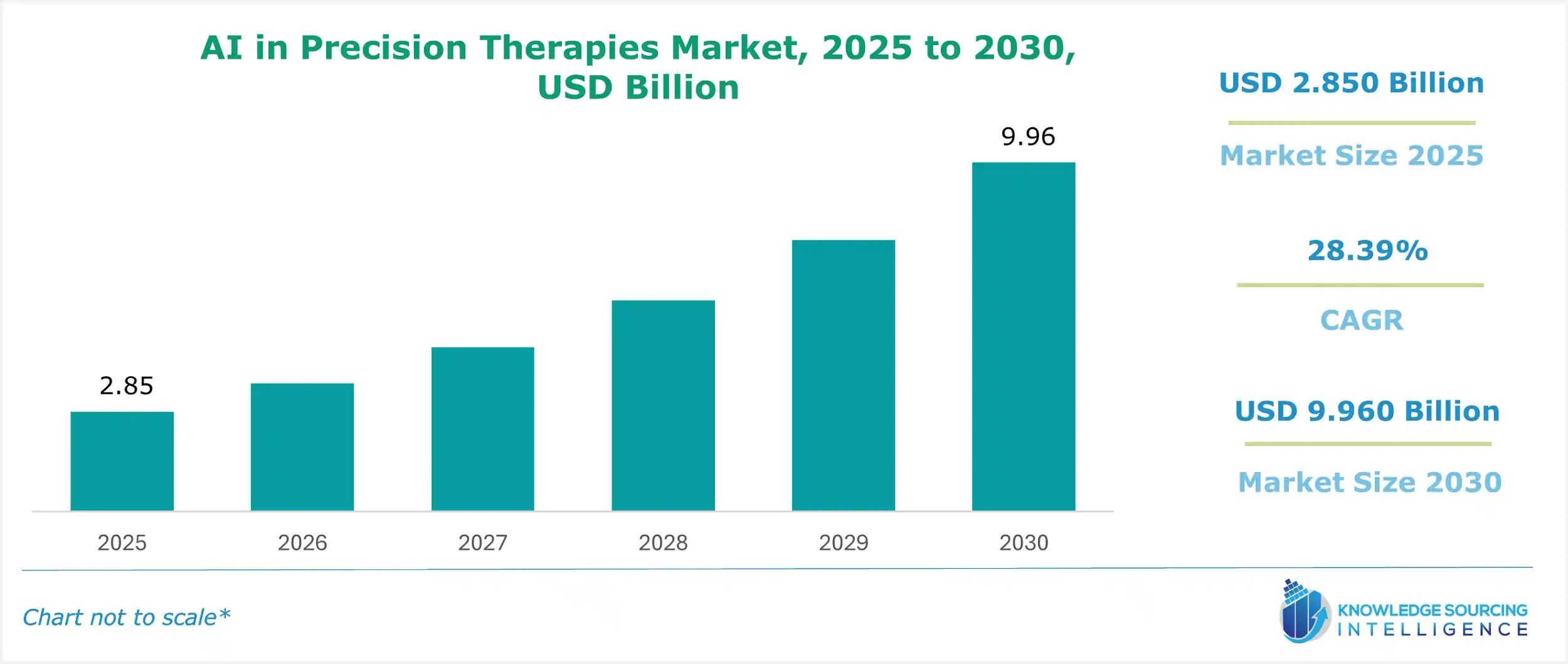
Artificial Intelligence (AI) In The Precision Therapies Market is expected to grow at a CAGR of 28.39%, reaching a market size of US$9.960 billion in 2030 and US$2.850 billion in 2025.
AI in the precision therapies market is a unique and disruptive method that is revolutionizing personalized medicine and patient care. Custom-made medication aims to tailor medical treatments to individual patients’ genetics, way of life, and disease characteristics to achieve the best results with the least side effects. Within this field, the application of AI technology has become much faster in exploring potential biomarkers, targets for drug action, options for treatment, and inefficient data management and stratification of patients. Suitable AI techniques can handle large volumes of patient records, genetic information, and outcomes from clinical trials, thus assisting healthcare providers in administering their patients with targeted medications and therapies.
The market of AI in precision therapies is considerably promising in that it could reshape the healthcare sector into more effective and patient-oriented therapies.
AI in the Precision Therapies Market Growth Drivers:
- Rising trends in personalized and precision medicine are increasing the Artificial Intelligence (AI) in precision therapies market growth.
AI technologies employed in precision therapies are rising due to changes in personalized and precision medicine. These changes stress the importance of customizing medical interventions to different patients who have varying genetic makeups, lifestyles, and disease characteristics. New technologies and molecular biology have made identifying various biomarkers and therapeutic targets possible, making treatment more accurate and specific. AI is pivotal in predicting treatment responses and disease outcomes through extensive datasets such as genomes, clinical data, and real-time patient information. The growing emphasis on the effectiveness of personalized or precision medicine in promoting positive patient outcomes has led to increased uptake of AI-based systems in precision therapeutics.
- Increasing the availability of big data in healthcare enhances AI in precision therapies market growth.
The growing availability of healthcare big data is a major driver of AI in the precision therapies market. Electronic health records, genetic sequences, medical imaging, and patient-generated data are all creating massive amounts of data in healthcare systems. This data offers important insights into illness patterns, treatment responses, and patient outcomes. AI systems can analyze this data to find patterns, develop novel biomarkers, and optimize precision medicines. The availability of healthcare big data allows for more accurate predictive modeling and personalized therapy suggestions, which improve precision medicine techniques. As data volumes increase, AI's role in capturing and understanding healthcare big data becomes increasingly important in creating precision medicines.
- Drug discovery and development propel AI in the precision therapies market growth.
Drug research and development enhancements are a significant driver of AI in the precision therapies industry. AI tools are speeding up target selection, lead optimization, and candidate screening in the traditional drug development process. To identify possible drug candidates, AI systems are capable of searching and evaluating large volumes of biomedical information, chemical structures, and clinical trials within a relatively shorter time frame and with more accuracy than human effort. AI spends less time in the medication discovery process and reduces the expenses associated with it because it can anticipate the interaction of drugs with their targets and assess the safety profile of the medicines under development. Implementing AI in the drug discovery process may enhance the accuracy of medications for many diseases and present new drug treatment possibilities.
- AI's contribution to clinical trial optimization boosts the AI in precision therapies market size.
Artificial intelligence's importance in optimizing clinical trials is another important area within the market of AI solutions for precision medicine. AI helps with patient recruitment, protocol design, and data management in clinical studies. Using AI algorithms, patient groups satisfying particular characteristics can be identified more quickly to facilitate recruitment and enhance the efficiency of the overall conduct of the trial. Using big data, AI examines how patients will respond to certain treatments, and this helps create better protocols and target patients. Monitoring safety and treatment effectiveness with AI in trial participants’ data ensures that issues are fixed in real time and enhances clinical trials' success. Using AI in clinical trial optimization translates to faster drug development timelines, reduced trial costs, and growth in targeted therapies.
AI in Precision Therapies Market Restraints:
- Rising security concerns are anticipated to impede market growth
Issues related to safeguarding patient data can affect the competitive advantage of a business. Since increasingly sensitive patient information like Social Security numbers, insurance ID numbers, addresses, and medical data is being used in AI systems, it is important to protect patient data. The increased adoption of precision medicine strategies is against sustained growth because threats are lurking in unauthorized access, leakage of data, and even abuse of such data. A restrictive legal regime further hinders the implementation of AI-based solutions in data privacy and data security laws, such as HIPAA in the United States.
AI in the Precision Therapies Market Geographical Outlook:
- North America is witnessing exponential growth during the forecast period
The US has led the research, development, and use of AI technology in precision medicine and therapeutics. It is not surprising that North America leads due to its well-established healthcare facilities, high-level AI funding, and large-scale pharmaceutical and biotech companies. In addition, the region's general trend towards personalized medicine and precision healthcare has created a market for AI-infused solutions that enhance treatment and patient outcomes. Advances in AI technologies will ensure that North America remains the largest shareholder in AI in the precision therapies market.
AI in the Precision Therapies Market Key Developments:
- October 2025: NetraMark Presents AI-Driven Advances in Precision Psychiatry at Joint Autumn Conference. NetraMark showcased explainable machine learning models for CNS clinical trial design, enhancing patient stratification and outcome prediction in precision psychiatry for depression and schizophrenia therapies.
- May 2025: Lunit Highlights AI's Role in Precision Oncology at ASCO 2025 with 12 Studies. Lunit presented 12 studies on its AI-powered digital pathology solution for precision oncology, including multimodal AI for immunotherapy response prediction and biomarker discovery in breast and lung cancers.
- July 2024: A team of engineers and biomedical researchers from the University of California, San Diego, made significant advances in creating a new generation of AI tools that enable the fast and inexpensive identification of clinically relevant genomic changes directly on tumor biopsy slides. A new AI protocol called DeepHRD for routine biopsy examination was recently published in the Journal of Clinical Oncology.
List of Top AI In Precision Therapies Companies:
- IBM Watson Health (IBM Corporation)
- Google Health (Alphabet Inc.)
- Tempus Labs, Inc.
- Nvidia Corporation
- Deep Genomics, Inc.
AI In Precision Therapies Market Scope:
| Report Metric | Details |
|---|---|
| Study Period | 2021 to 2031 |
| Historical Data | 2021 to 2024 |
| Base Year | 2025 |
| Forecast Period | 2026 – 2031 |
| Report Metric | Details |
|
AI in Precision Therapies Market Size in 2025 |
US$2.850 billion |
|
AI in Precision Therapies Market Size in 2030 |
US$9.960 billion |
| Growth Rate | CAGR of 28.39% |
| Study Period | 2020 to 2030 |
| Historical Data | 2020 to 2023 |
| Base Year | 2025 |
| Forecast Period | 2025 – 2030 |
| Forecast Unit (Value) | USD Billion |
| Segmentation |
|
| Geographical Segmentation | North America, South America, Europe, Middle East and Africa, Asia Pacific |
|
List of Major Companies in AI in Precision Therapies Market |
|
| Customization Scope | Free report customization with purchase |
AI In Precision Therapies Market Segmentation:
- By Therapy Type
- Personalized Medicine
- Targeted Therapies
- Gene Therapies
- Cell Therapies
- Immunotherapies
- Others
- By Application
- Oncology
- Neurology
- Cardiology
- Infectious Diseases
- Rare Diseases
- Autoimmune Diseases
- Others
- By End-User Industry
- Hospitals And Clinics
- Pharmaceutical And Biotechnology Companies
- Research Institutes And Academic Centers
- Others
- By Geography
- North America
- United States
- Canada
- Mexico
- South America
- Brazil
- Argentina
- Others
- Europe
- United Kingdom
- Germany
- France
- Italy
- Spain
- Others
- Middle East and Africa
- Saudi Arabia
- UAE
- Others
- Asia Pacific
- Japan
- China
- India
- South Korea
- Taiwan
- Thailand
- Indonesia
- Others
- North America