Report Overview
Artificial Intelligence (AI) In Highlights
AI in Precision Medicine Market Size:
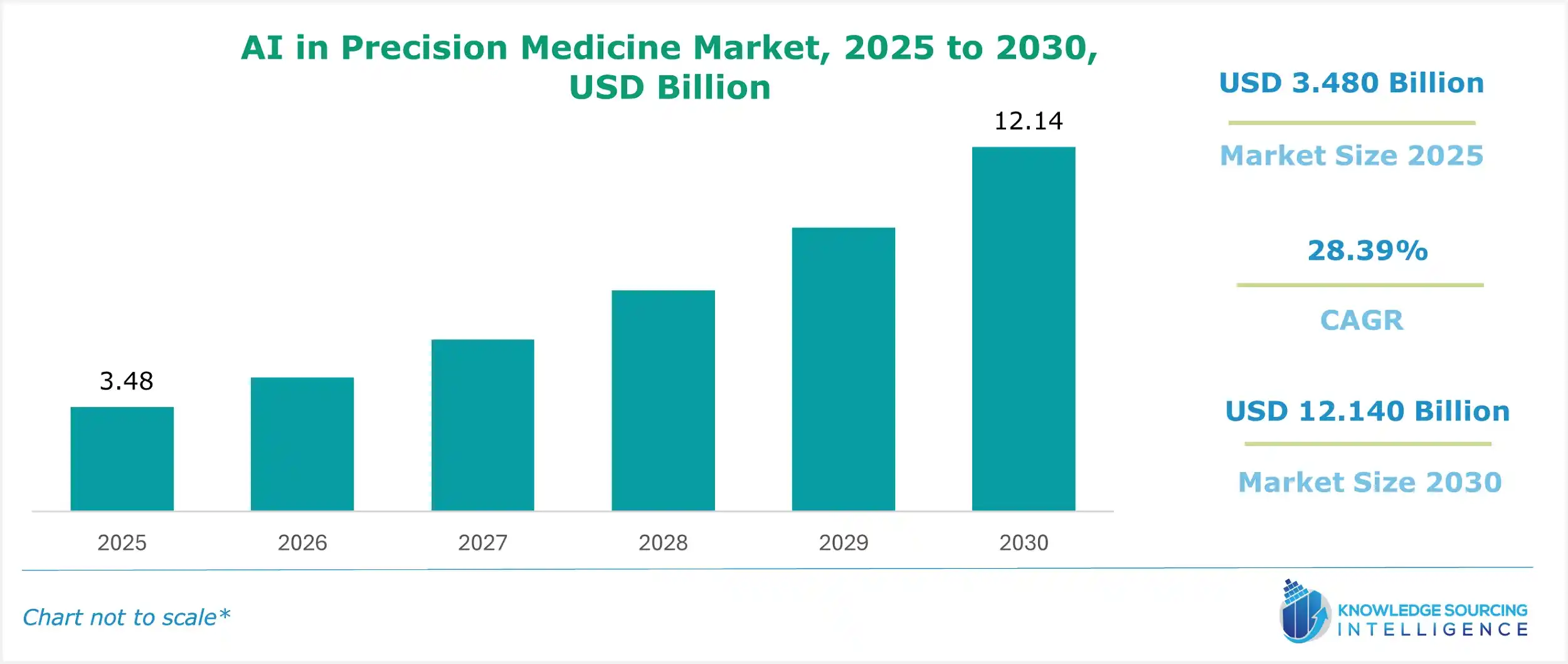
The AI in Precision Medicine Market is expected to grow at a CAGR of 28.39%, reaching a market size of US$12.140 billion in 2030 from US$3.480 billion in 2025.
Artificial intelligence (AI) has found its application in various fields, including precision medicine. AI is merging technology with healthcare, propelling the market in the projected period. AI algorithms and machine learning techniques have allowed for the study of massive volumes of patient data, such as genetic profiles, medical records, and lifestyle information, to provide personalized and targeted treatment solutions.
AI in the precision medicine market is expanding rapidly as healthcare providers and pharmaceutical firms see its potential to improve patient outcomes, increase diagnosis accuracy, and expedite drug discovery processes. AI-enabled systems can then unveil patterns and connections from such large amounts of data to predict the risk of disease and formulate risk-based therapies. As AI continues to evolve, it holds great promise of reshaping precision medicine in the future since it offers novel ways to implement personalized healthcare approaches and change the paradigm for patient care.
AI in Precision Medicine Market Growth Drivers:
- Improvement in data analytics and machine learning algorithms empowers AI to drive growth in the precision medicine market:
The development of data analytics and machine learning algorithms has played an important role in AI in the precision medicine business. These developments have enabled healthcare practitioners to process huge and complex datasets, gain valuable insights from them, and construct personalized treatment approaches with ease. Machine learning algorithms screen for patterns and relationships in patient data that, in turn, support diagnosis, prognosis, and assessment of treatment response of certain diseases. These algorithms are increasingly accurate and more proficient, hastening the use of AI in precision medicine by providing healthcare professionals with strong tools with which to apply targeted and effective therapies to improve patient outcomes.
- Increasing demand for personalized and targeted approaches to treatment in AI precision medicine:
The increasing demand for personalized and tailored care has helped AI advance in the precision medicine sector. The traditional healthcare models denote standard treatment methods devoid of considerations for individual variations and unique requirements. However, with developments in artificial intelligence, healthcare practitioners can now apply knowledge specific to patients to create tailored therapies. This will likely be done by processing different types of information, such as genetic makeup, medical background, lifestyle, and environmental data, using AI systems that set up treatment options. This will probably translate to better therapeutic effectiveness with fewer adverse effects and overall good patient results. Better knowledge of precision medicine has been about delivering more accurate and effective health interventions, driving the demand for AI applications.
- Artificial Intelligence in the Precision Medicine Market: Towards Better Patient Outcomes and Treatment:
AI has also been applied to precision medicine to improve patient outcomes and treatment efficacy. A recent study by the Journal of Medical Internet Research found that AI-based treatments in precision medicine reduced adverse events by 14% and hospital readmissions by 25%. These studies show that AI is effective in optimizing treatment regimens to find successful medications and lowering healthcare expenditures. The power of analytics that AI holds may lead healthcare professionals to better decisions and data-driven insights for better patient outcomes, greater efficacy of treatment, and, finally, quality of care.
AI in Precision Medicine Market Geographical Outlook:
- North America is the market leader in AI in precision medicine.
North America has emerged as the leading market in AI in precision medicine. Several factors contribute to the region's leading position in the market. First, the health infrastructure is well-developed in North America, and so is the pace of technology innovation, thereby favoring the usage of AI in precision medicine. The headquarters of leading pharmaceutical and biotechnology companies are situated in North America, along with research institutes and academic centers. This further strengthens the company's leading position in the market.
Considerable AI research and development investments have been observed in the region, further encouraging innovation in precision medicine. Additionally, North America has a friendly regulatory framework with supportive policies for adopting artificial intelligence in healthcare.
- Integrating AI with Genomic Sequencing and Precision Medicine Enhances the AI in Precision Medicine Market Size.
In the healthcare business, integrating AI with genome sequencing and precision medicine has become a crucial growth element. Genomic sequencing creates massive volumes of genetic data, which can then be analyzed with AI algorithms to uncover disease-associated genetic variants and inform personalized treatment options.
AI in Precision Medicine Market Key Developments:
- November 2025: Tempus Announces Six Abstracts Accepted for Presentation at SITC 2025. Tempus revealed six abstracts showcasing AI-driven precision oncology research, including multimodal AI models for immunotherapy response prediction and biomarker discovery in cancer treatment, advancing personalized therapies.
- October 2025: Tempus Collaborates with Whitehawk Therapeutics on Biomarker-Driven Oncology Research. Tempus partnered with Whitehawk Therapeutics to leverage AI for identifying novel biomarkers in oncology, accelerating precision medicine development through genomic data analysis and predictive modeling.
- September 2025: SOPHiA GENETICS Expands Collaboration with AstraZeneca for Cancer Detection. SOPHiA GENETICS and AstraZeneca extended their partnership to enhance AI-powered detection of breast and prostate cancer using multimodal data analysis, improving precision diagnostics and therapeutic targeting.
AI in Precision Medicine Market: A Deep Dive into Company Products:
- Genomic Sequencing: Tempus conducts whole-genome sequencing to generate high-quality genetic data. These could then be combined with clinical data to decipher insights into disease development and therapy response.
- Collaboration in Research: 23andMe collaborated with academic institutions and pharmaceutical companies to create large genetic and phenotypic information databases. Using AI, researchers analyze the huge dataset to find genetic insights, which will eventually help in finding new targets for treatment.
List of Top AI in Precision Medicine Companies:
- Ibm Corporation
- Google LLC (Alphabet Inc.)
- Microsoft Corporation
- Amazon Web Services (AWS)
- Intel Corporation
AI in Precision Medicine Market Scope:
| Report Metric | Details |
|---|---|
| Study Period | 2021 to 2031 |
| Historical Data | 2021 to 2024 |
| Base Year | 2025 |
| Forecast Period | 2026 – 2031 |
| Report Metric | Details |
| AI in Precision Medicine Market Size in 2025 | US$3.480 billion |
| AI in Precision Medicine Market Size in 2030 | US$12.140 billion |
| Growth Rate | CAGR of 28.39% |
| Study Period | 2020 to 2030 |
| Historical Data | 2020 to 2023 |
| Base Year | 2025 |
| Forecast Period | 2025 – 2030 |
| Forecast Unit (Value) | USD Billion |
| Segmentation |
|
| Geographical Segmentation | North America, South America, Europe, Middle East and Africa, Asia Pacific |
| List of Major Companies in AI in Precision Medicine Market |
|
| Customization Scope | Free report customization with purchase |
AI in Precision Medicine Market Segmentation:
- By Technology
- Machine Learning
- Natural Language Processing (NLP)
- Deep Learning
- Big Data Analytics
- Others
- By Application
- Drug Discovery and Development
- Oncology
- Genetic Testing
- Rare Diseases
- Infectious Diseases
- Others
- By End-User
- Pharmaceutical And Biotechnology Companies
- Research Institutes And Academic Centers
- Healthcare Providers
- Others
- By Geography
- North America
- United States
- Canada
- Mexico
- South America
- Brazil
- Argentina
- Others
- Europe
- United Kingdom
- Germany
- France
- Italy
- Spain
- Others
- Middle East and Africa
- Saudi Arabia
- UAE
- Others
- Asia Pacific
- Japan
- China
- India
- South Korea
- Indonesia
- Taiwan
- Others
- North America