Report Overview
Total Organic Carbon Analyzer Highlights
Total Organic Carbon Analyzer Market Size:
The total organic carbon analyzer market is evaluated at US$1,569.434 million in 2025, growing at a CAGR of 4.63%, reaching the market size of US$1,968.033 million by 2030.
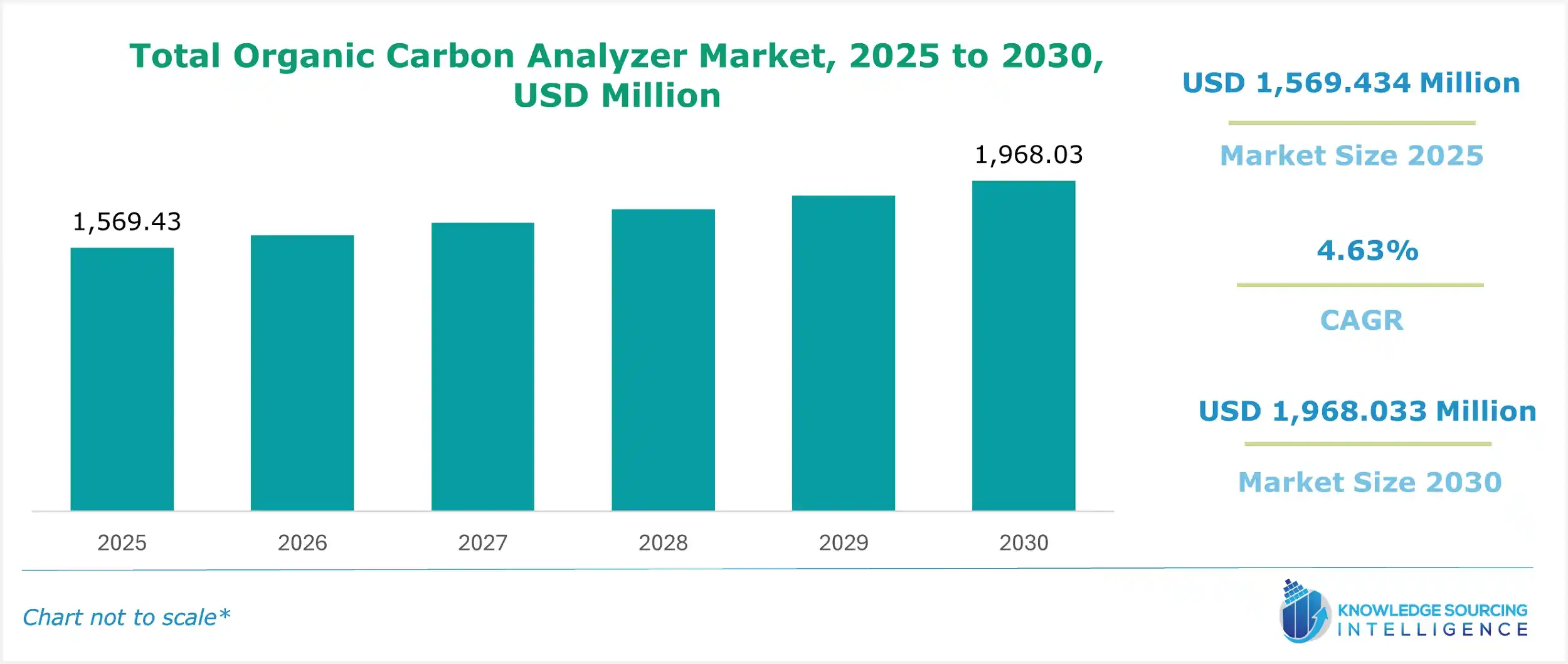
Total organic carbon (TOC) is one of the most important parameters for assessing the organic pollution of water. The importance of total organic compounds cannot be understated since they are directly correlated with the well-being of society. The total organic carbon is more specifically measured for maintaining the process control by the firms in different industry verticals while simultaneously requiring the total organic carbon analysis to be conducted as a regulatory compulsion.
For instance, municipal authorities must monitor the wastewater's organic carbon level before discharging it into the surface waters. As such, the total organic carbon analyzer market has been increasing steadily. The total organic carbon analysis also tends to provide more accurate results and a wider scope than the biological and chemical oxygen demand tests. Moreover, the government's efforts in developing regions to increase the accessibility of safe drinking water to a larger proportion of the population are anticipated to supplement market growth further.
Total Organic Carbon Analyzer Market Drivers:
- Increasing efficiency of UV oxidation is anticipated to increase market growth.
Due to its versatility, accuracy, and efficiency in quantifying the quantity of organic carbon in a variety of liquid samples, the UV oxidation technique is now the preferred method. UV oxidation TOC analyzers quantify the quantity of TOC in organic substances by oxidizing them to carbon dioxide with ultraviolet light. Since it doesn't involve combustion or high temperatures, this process is especially beneficial for a range of sample types, such as the sensitive solutions that are applied in the biotech and pharmaceutical fields. The procedure typically provides results in real-time or almost real-time, which is crucial for companies that require continuous monitoring and must implement rapid process changes.
- Increasing demand for wastewater treatment is estimated to boost market growth.
The TOC analyzers market will be driven substantially over the next few years due to the need for wastewater analysis. According to the US Environmental Protection Agency (EPA)[1], approximately 75% of the country's population is covered by over 16,000 publicly owned treatment plants, which treat some 32 billion gallons of wastewater daily. Environmental safety and regulatory compliance demand ongoing monitoring and analysis of this vast amount of wastewater. Since they quantify the total quantity of carbon in organic matter in water—a significant measure of water quality and treatment efficiency—TOC analyzers are an essential part of it.
- Growing need for water quality monitoring
The broad and critical function of water quality monitoring in ensuring the security and compliance of water sources in many different industries establishes it as a crucial application. Measurements and control of organic carbon levels in potable water, wastewater, surface water, and process water for the industry are typically made and regulated through TOC analyzers. The demand for precise and reliable TOC analysis is increasing due to rising global concerns regarding water pollution and the necessity for strict regulatory compliance. Improvements in TOC analyzer technology, providing higher sensitivity, faster analysis times, and higher reliability, are extremely useful to this application. These characteristics are critical in identifying remnants of organic pollutants that can potentially destroy the environment and human health by degrading water quality.
Total Organic Carbon Analyzer Market Restraints:
- High maintenance costs
Even though maintenance expenses are an important factor in the market for TOC analyzer analyzers, their impact on growth is expected to be moderate instead of substantial. The total annual maintenance expense of water quality monitoring instruments, including TOC analyzer analyzers, is between 5% and 15% of the initial acquisition price, according to a study by the EPA. This translates to $1,000 to $3,000 in yearly maintenance expenses for a standard TOC analyzer, which retails for approximately $20,000. Although these expenses are considerable, they are typically covered by the importance of TOC analyzers in maintaining water quality and regulatory compliance for numerous industries.
Total Organic Carbon Analyzer Market Geographical Outlook:
- Asia Pacific is witnessing exponential growth during the forecast period.
Geographically, the Asia Pacific total organic carbon analyzer market is estimated to have a significant share due to the semiconductor industry's growing production and the government's increasing effort to improve the accessibility of safe drinking water to households. Moreover, the power plant capacity has been rising in the region, and there has been increasing focus on reducing the plant downtime caused by the contamination of the water or problems in the chemistry of the water-stream circuit by ensuring effective and continuous analysis of the organic content. Simultaneously, the North American total organic carbon analyzer market is projected to grow rapidly due to a large number of drug development projects along with the strict regulatory compliance requirement by firms in different industry verticals.
Total Organic Carbon Analyzer Market Key Launches:
- In April 2024, The QbD1200+ Total Organic Carbon (TOC) Analyzer was introduced by Beckman Coulter Life Sciences, a world leader in laboratory automation and innovation. It is made to comply with 21 CFR Part 11 requirements and the main international pharmacopeia regulations, including USP, EP, JP, IP, and KP, and it provides streamlined validation and reporting on encrypted data.
Total Organic Carbon Analyzer Market Scope:
| Report Metric | Details |
|---|---|
| Study Period | 2021 to 2031 |
| Historical Data | 2021 to 2024 |
| Base Year | 2025 |
| Forecast Period | 2026 – 2031 |
| Report Metric | Details |
| Total Organic Carbon Analyzer Market Size in 2025 | US$1,569.434 million |
| Total Organic Carbon Analyzer Market Size in 2030 | US$1,968.033 million |
| Growth Rate | CAGR of 4.63% |
| Study Period | 2020 to 2030 |
| Historical Data | 2020 to 2023 |
| Base Year | 2024 |
| Forecast Period | 2025 – 2030 |
| Forecast Unit (Value) | USD Million |
| Segmentation |
|
| Geographical Segmentation | North America, South America, Europe, Middle East and Africa, Asia Pacific |
| List of Major Companies in the Total Organic Carbon Analyzer Market |
|
| Customization Scope | Free report customization with purchase |
Total Organic Carbon Analyzer Market Segmentation:
By Type
By Application
- Industrial Wastewater
- Drinking Water
- Ground Water
- Cooling Water
- Seawater
- Pure Water
By Technology
- Ultraviolet Oxidation
- Ultraviolet Persulfate Oxidation
- High-Temperature Combustion
By Industry Vertical
- Pharmaceutical
- Oil & Gas
- Environment
- Food & Beverage
- Semiconductor
- Chemical
- Others
By Geography
- North America
- United States
- Canada
- Mexico
- South America
- Brazil
- Argentina
- Others
- Europe
- Germany
- France
- Spain
- United Kingdom
- Others
- Middle East and Africa
- UAE
- Saudi Arabia
- Others
- Asia Pacific
- China
- Japan
- India
- South Korea
- Thailand
- Indonesia
- Taiwan
- Others
Our Best-Performing Industry Reports:
- Carbon Capture, Utilization And Storage Market
- Advanced Carbon Materials Market
- Global Hydrocarbon Market