Report Overview
Artificial Intelligence (AI) In Highlights
AI in Media And Entertainment Market Size:
The Global Artificial Intelligence (AI) in Media and Entertainment market is forecast to grow at a CAGR of 31.8%, reaching USD 277.5 billion in 2031 from USD 69.7 billion in 2026.
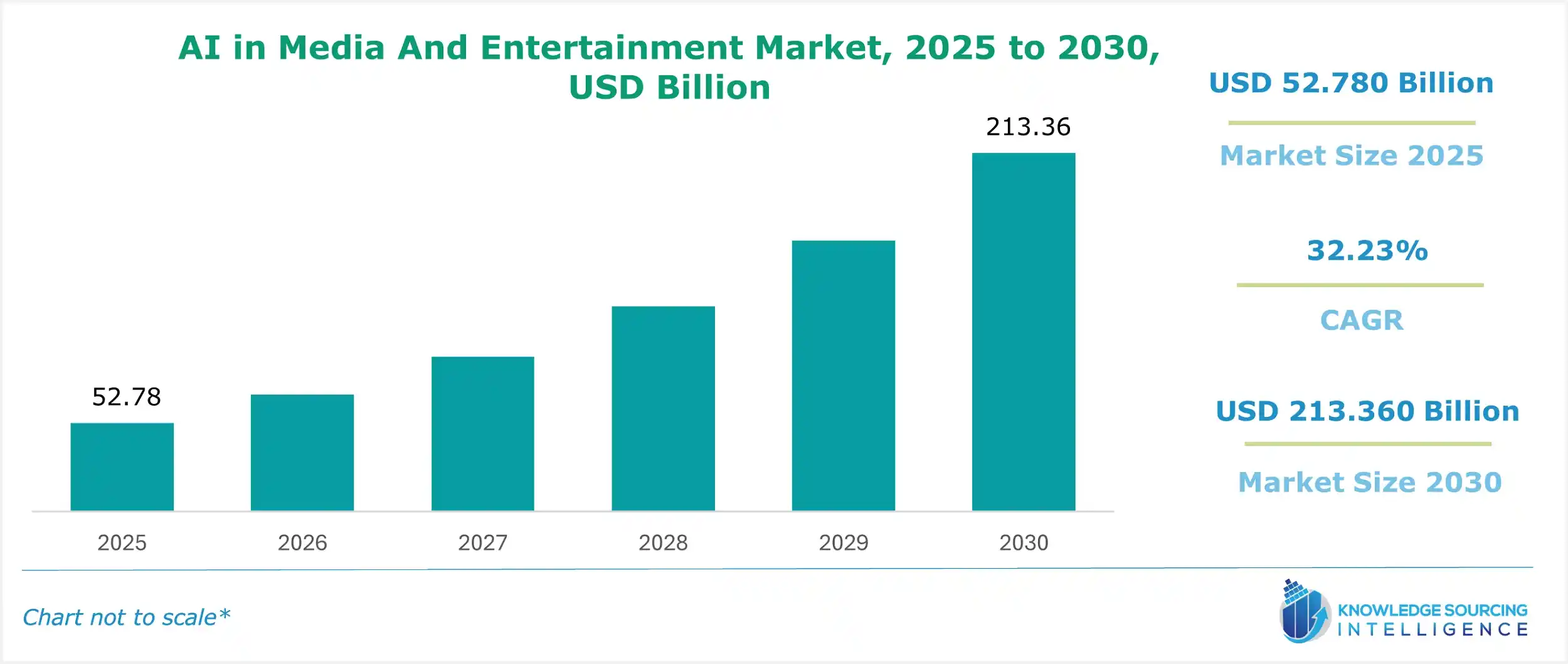
The application of artificial intelligence (AI) technology and software products in the media and entertainment market encompasses a range of sub-sectors, such as gaming, video production, content production, and other related fields.
The media and entertainment sector's evolution and diversification are driving the use of AI software and applications for several tasks. These include the production of subtitles, personalizing media content for consumers, and the development of innovative editing tools and filters. Since the media and entertainment sector is just now beginning to use AI, this market will grow significantly throughout the forecast period.
AI in Media and Entertainment Market Growth Drivers:
Burgeoning content generated by the media and entertainment industries is anticipated to propel market growth
The large-scale upsurge in the content volume generated within the global media and entertainment sector leads to several chances for utilizing AI-based apparatuses in the field. The emergence of influential individuals and video streaming content producers, especially on social networking sites like TikTok, Instagram, Facebook, YouTube, etc., has tremendously increased the amount of content being produced within this industry. For example, a report released by “Wallaroo Media” indicates that over 83% of all TikTok users also post videos on the platform. Consequently, firms advertising their commodities through these platforms become even more visible worldwide. Therefore, this presents an opportunity to use AI tools to organize and categorize online content.
Software with AI capabilities improves and expands the variety of online content produced. For example, Snapchat and Vogue recently teamed up to introduce a special augmented reality function that allows Snapchat users to take their picture or video wearing a specific item of clothing. Because of this, the media and entertainment industry's use of AI software is becoming more widespread on all the platforms where content creation is accelerating.
Advancements in the gaming and animation sector are anticipated to drive the market growth
Due to better resolution and graphics, gaming, animation, and visual effects have grown rapidly over the years, resulting in the growth of the gaming industry and other such sectors worldwide. Moreover, there are several reasons why the animation and cartooning sector has increased, such as its rising exposure on numerous platforms such as YouTube, Netflix, and other online video streaming sites.
Additionally, this advancement is driven by a growing demand for gaming and animated products. AI-controlled technologies benefit these industries by enhancing body movements, replicating facial expressions and actions, and matching voices to characters in games like Call of Duty. Because of this, the expansion of AI within the media and entertainment sectors will be driven by increased content in terms of quantity produced, together with subsequent innovations across various sub-fields constituting it.
Enhanced user experience
Businesses use AI to improve user experiences by offering customized content based on each user's interests. This is especially noticeable while users browse video platforms, as AI algorithms guarantee stability for users with different Internet speeds and bandwidths. To illustrate, Netflix, a popular streaming service, has integrated AI technology to improve and personalize user experience. AI-based systems perform various machine learning pipelines for personalized suggestions for TV series, movies, and other content.
This is expected to boost development because of the supportive measures taken by the government. AI systems are essential for identifying objects and actions during athletic events. These systems improve broadcasts by adding interesting content and in-depth sports analysis using drone footage. AI-based live video in the context of a football game can record players and fan reactions and actions following every goal. The goal of the visual components incorporated into the live broadcast is to create an engaging story for the viewers.
AI in Media and Entertainment Market Restraints:
Privacy concerns and data security issues are anticipated to impede market growth
The application of AI in content personalization processes for customers requires access to their streaming history and cookie history across other platforms to better analyze the customer’s preferences and behavior. Although prior consent is obtained before using such customer personal details, there is a chance that such private information may be misused through hacking activities. As a result, customers are reluctant to give these platforms access permissions, which creates inaccurate personalized playlists and watchlists for the customers.
AI in Media and Entertainment Market Geographical Outlook:
North America is witnessing exponential growth during the forecast period
In AI technologies, North America has been dominated by several technological giants, renowned research institutions, and avant-garde start-ups. R&D done by these organizations enhances AI applications in the media and entertainment sector. In addition, North America provides amenable conditions for adopting and utilizing AI solutions owing to its robust digital infrastructure and high internet penetration rates.
Digital content can be produced, shared, and consumed using this infrastructure, enabling AI technologies to flourish. For instance, TIME and OpenAI announced their partnership in June 2024 to merge TIME’s esteemed journalism into OpenAI products like ChatGPT. Through the partnership, OpenAI can improve its products and give proper credit to sources by accessing TIME's vast archives. In exchange, TIME will have access to OpenAI's technology to create new goods and improve how news is delivered. The collaboration seeks to increase access to reliable and accurate information on a global scale.
AI in Media and Entertainment Market Key Developments:
In May 2024, there was an announcement about a partnership allowing OpenAI’s ChatGPT AI chatbot to access and display content from more than twelve news sites owned by News Corp. How people view the news may be changed by the degree of blending between AI and journalism. The experts believe it is an attempt to enhance ChatGPT’s capabilities and compete with Google Search through this alliance. Digital integration is redefining consumer needs in the age of needing a "super app" that makes daily activities simpler, hence rising demand.
In November 2023, ZEE Entertainment Enterprises and Nasscom launched the Generative AI Foundry program to support AI startups in India. The Technology and Innovation Centre at ZEE will focus on enabling and supporting India’s media and entertainment industry’s generative AI solutions as part of this partnership. They organized a one-day workshop as part of their aim, which focuses on enabling start-ups within an ever-changing AI environment. Nasscom’s Generative AI Foundry program is expected to improve India’s position in the global AI startup arena.
List of Top AI in Media And Entertainment Companies:
Amazon Web Services Inc.
Gravity Media
GrayMeta
IBM Corporation
Microsoft Corporation
AI in Media And Entertainment Market Scope:
| Report Metric | Details |
|---|---|
| Study Period | 2021 to 2031 |
| Historical Data | 2021 to 2024 |
| Base Year | 2025 |
| Forecast Period | 2026 – 2031 |
| Companies |
|
Report Metric | Details |
AI in Media And Entertainment Market Size in 2025 | US$52.780 billion |
AI in Media And Entertainment Market Size in 2030 | US$213.360 billion |
Growth Rate | CAGR of 32.23% |
Study Period | 2020 to 2030 |
Historical Data | 2020 to 2023 |
Base Year | 2025 |
Forecast Period | 2025 – 2030 |
Forecast Unit (Value) | USD Billion |
Segmentation |
|
Geographical Segmentation | North America, South America, Europe, Middle East and Africa, Asia Pacific |
List of Major Companies in AI in Media And Entertainment Market |
|
Customization Scope | Free report customization with purchase |
The Artificial Intelligence (AI) in media and entertainment market is segmented and analyzed as follows:
By Application
Gaming
Video Production
Plagiarism Detection
Personalization
Production Management
Others
By Geography
North America
USA
Canada
Mexico
South America
Brazil
Argentina
Others
Europe
United Kingdom
Germany
France
Italy
Spain
Others
Middle East and Africa
Saudi Arabia
UAE
Others
Asia Pacific
China
Japan
India
South Korea
Australia
Singapore
Indonesia
Others